Most HVAC optimization pilots wait too long to talk about measurement. The project starts with a model, a dashboard, or a set of recommendations. Then, after the pilot is already running, someone asks the question that should have been answered before deployment: how will we know whether this actually saved energy?
That order creates avoidable ambiguity. If savings are going to matter commercially, the measurement path has to be designed before the pilot starts, before the control strategy changes the operating history that everyone later wants to use as evidence.
Measurement is part of the deployment design
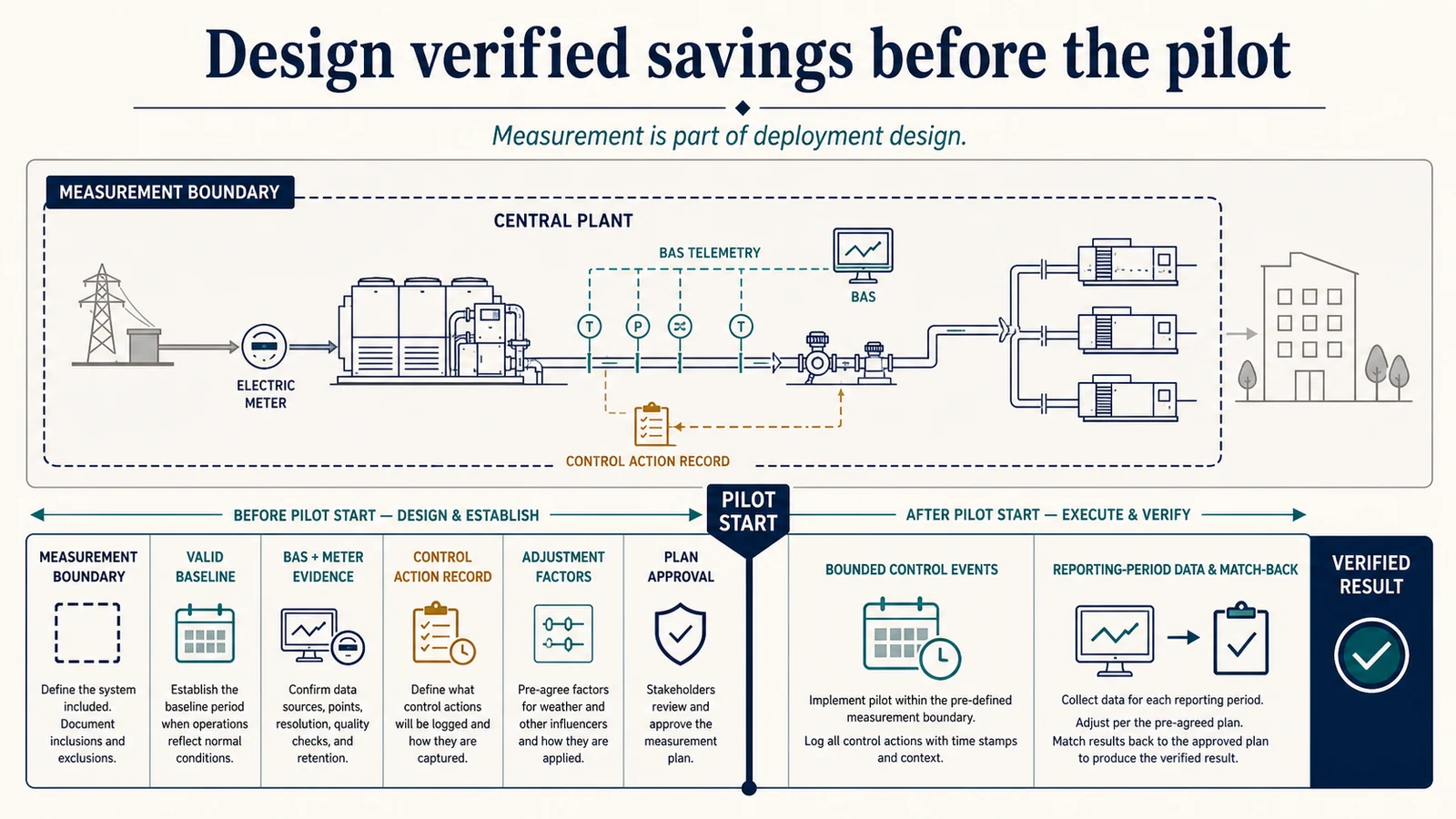
For a central plant optimization project, measurement should not be treated as a final slide. It is part of the operating design. The team needs to know which system is inside the measurement boundary, which meters or BMS points will be used, which baseline period is valid, and which operating changes need to be normalized.
Those decisions affect more than reporting. They shape the pilot itself. A project that cannot connect control actions to meter or telemetry evidence is still useful for learning, but it should not be sold internally as verified savings.
The boundary keeps the savings claim honest
The first question is the measurement boundary. Is the project measuring the whole facility, the central plant, the chillers, the pumps, the cooling towers, or a specific control measure such as chilled-water supply reset?
Without that boundary, the savings claim can drift. Tenant schedules, weather, maintenance events, comfort overrides, equipment faults, or unrelated load changes can all move the energy number. A defensible pilot names what is inside the scope and what is not.
The baseline has to survive operations
The second question is the baseline. A useful baseline is not just historical data. It is historical data that can be compared to the reporting period in a way the facility team and asset owner can understand.
For some pilots, that may mean a weather-normalized historical comparison. For others, it may mean alternating operating days, comparable load windows, or an IPMVP-aligned M&V plan when the customer needs settlement-grade evidence. The right method depends on the commercial use of the savings claim.
Control actions need an evidence trail
A serious supervisory control pilot should also preserve the link between action and outcome. If the system adjusts a setpoint, changes a sequence, or recommends a staging decision, that event should be visible alongside the approved control envelope and the measurement data used afterward.
That creates a cleaner operating record:
- Which setpoint, sequence, or reset changed.
- Which comfort, equipment, schedule, or operator boundary allowed the action.
- Which meter, BMS trend, or power signal will be used to evaluate the result.
- Which conditions changed during the same period and may need adjustment.
- Whether the facility team approved, overrode, or reversed the action.
Verified savings are an accountability layer
This is why measurement and verification is not just a compliance exercise. In HVAC optimization, it is an accountability layer between software control and business value.
Facility teams need to know the system did not create comfort or equipment risk. Energy managers need to know the result is not only a model output. Asset owners need to know whether the impact is large and reliable enough to justify rollout.
The best HVAC optimization projects design that evidence path up front: start with the existing BMS, define the control envelope, run the pilot, measure the result, and keep the evidence visible.