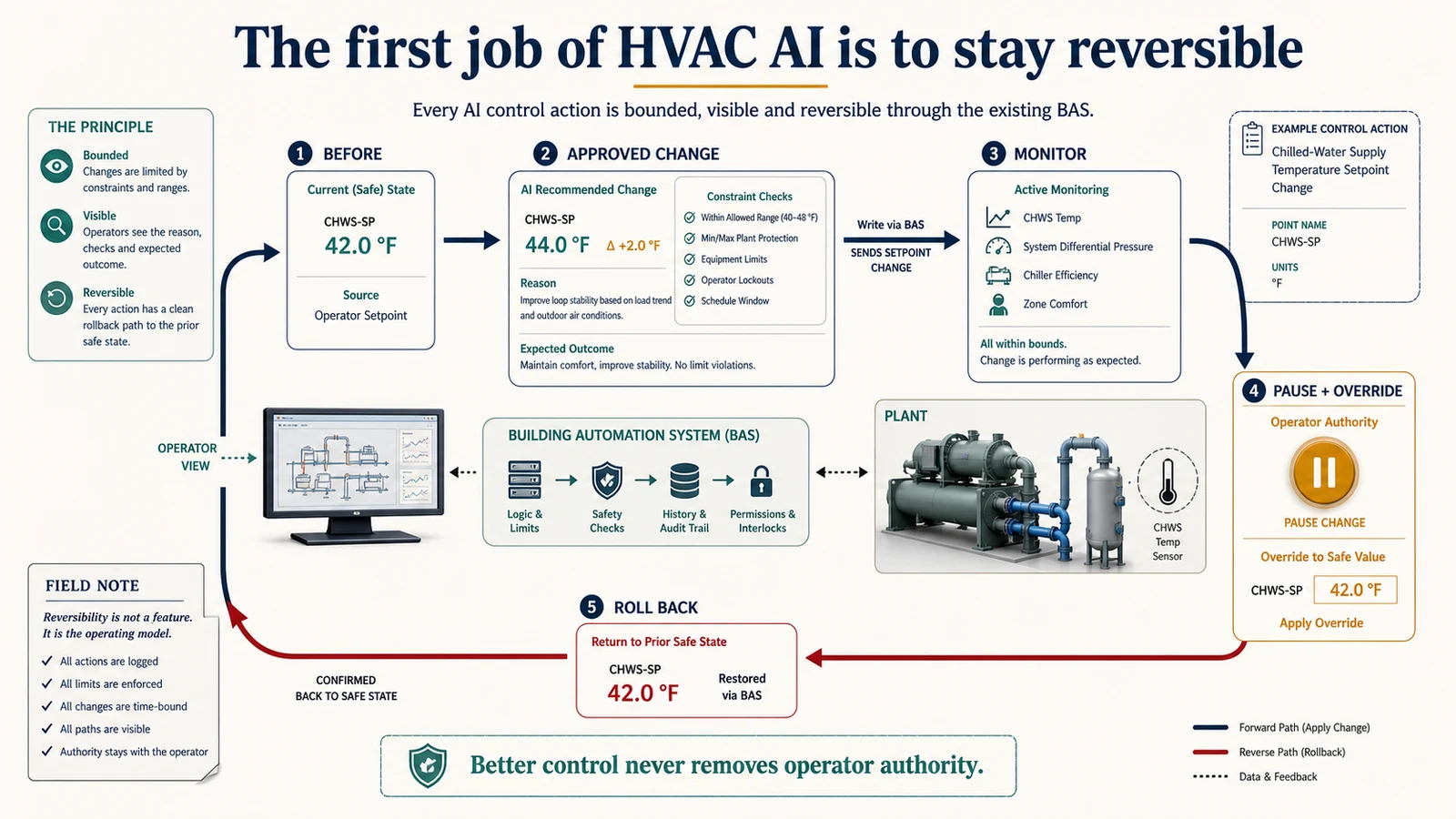
The first job of HVAC AI is to stay reversible. That may sound less exciting than prediction, optimization, or autonomy, but in a real commercial building, reversibility is what makes control acceptable.
If a supervisory system changes a chilled-water setpoint, resets a condenser-water schedule, or adjusts an equipment staging decision, the facility team needs to know what changed, why it changed, which boundary allowed it, and how to roll it back.
Reversibility is an operating requirement
Commercial HVAC is not a clean software-only environment. A central plant has equipment protections, local sequences, comfort obligations, maintenance realities, and operators who are accountable when something goes wrong.
That is why a useful optimization layer should not ask the building team to absorb the risk of a black-box control action. It should make the action inspectable before, during, and after execution.
- Which BMS points did the system observe?
- Which setpoint or command did it change?
- Which comfort, equipment, schedule, or operator limits were checked first?
- Which approved control envelope allowed the action?
- How can the operator override or reverse it?
- What evidence will be used to measure the result afterward?
The BMS remains the system of record
Good HVAC AI should sit above the existing BMS, not replace it. The BMS remains the system of record for local control, equipment safeties, operator overrides, point permissions, and the building team's daily workflow.
The supervisory layer should make that infrastructure more valuable by turning BMS data and approved constraints into bounded action. It should leave the building in a state the operator can understand, not in a state that only the model can explain.
Shadow mode is how the boundary earns trust
Reversible control also changes the deployment path. Instead of starting with closed-loop autonomy, the system can begin in shadow mode: observe the plant, compare proposed decisions against current operation, and show the limits it would respect.
That creates a practical approval process. The facility team can see where the optimization layer would act, where it would hold back, and which actions are safe enough to move into supervised control.
Better control should not remove authority
The goal is not to make operators disappear. The goal is to make better plant operation possible without taking away their authority.
For central plant optimization, autonomy earns trust by being constrained, visible, measurable, and reversible. Those requirements are not a limitation of the technology. They are the conditions that let the technology survive contact with real buildings.