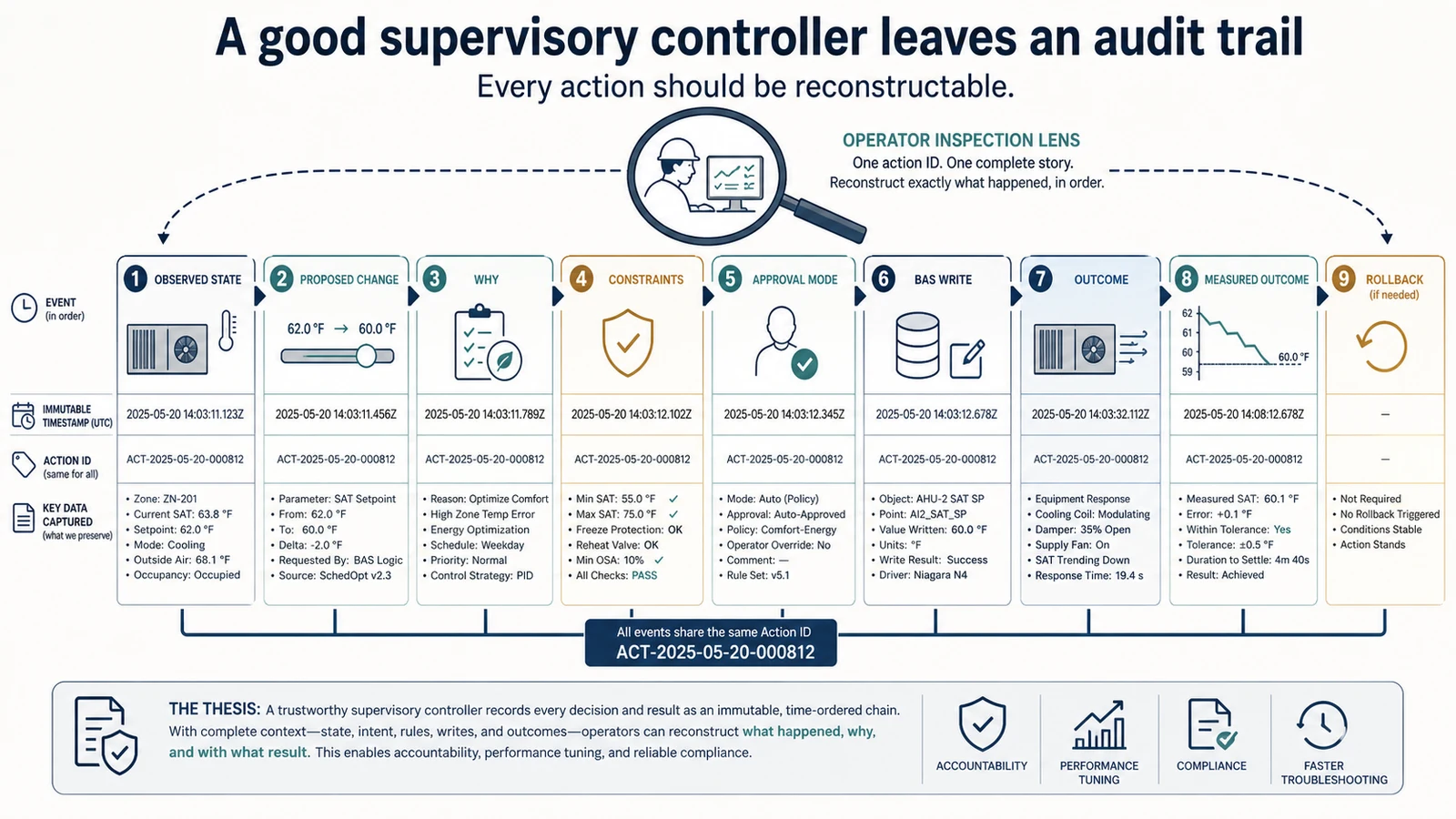
A good supervisory controller should leave an audit trail.
That sounds like an operations detail.
I think it is one of the most important requirements for HVAC AI.
If a system is going to adjust plant behavior, the facility team should be able to answer a few basic questions:
- What did it change?
- Why did it change it?
- Which constraint allowed the action?
- Which limits were checked first?
- Who approved the control envelope?
- What happened afterward?
- How do we reverse it if needed?
Black boxes do not last in real buildings
Without that record, supervisory control starts to feel like a black box.
And black boxes do not last long in real buildings.
Commercial HVAC is not a place where "the model decided" is a sufficient explanation. Operators need to know whether a chilled-water setpoint reset was driven by load, weather, equipment state, tariff pressure, comfort margin, or a constraint that temporarily tightened the operating envelope.
Energy managers need to know whether the action actually contributed to verified savings.
Owners need to know that optimization did not quietly trade energy reduction for comfort complaints, equipment stress, or operational risk.
Auditability is part of the product
This is why an audit trail is not just compliance paperwork.
It is part of the control product.
A good supervisory layer should make every action visible, explainable, reversible, and measurable.
It should sit above the existing BMS, respect local sequences, and leave the building team with a clear record of what happened.
At ClimaMind, this is how we think about trustworthy HVAC optimization:
Do not just optimize the plant.
Show the reasoning.
Show the boundary.
Show the result.
Because the systems that earn operator trust are not the ones that only make better decisions.
They are the ones that make better decisions in a way people can inspect, challenge, and keep using.