Unified cooling-system solution

Supervisory Optimization.

Apply AI HVAC optimization to chillers, pumps, cooling towers, and selected setpoints as one coordinated commercial and industrial energy-saving system.

Low-disruption

Integration

Maintained

Operator authority

  • Whole-system optimization instead of isolated equipment tuning
  • Low-disruption integration through approved BMS/BAS access paths
  • accountable autonomy inside an operator-approved envelope

The control problem

Supervision, not observation.

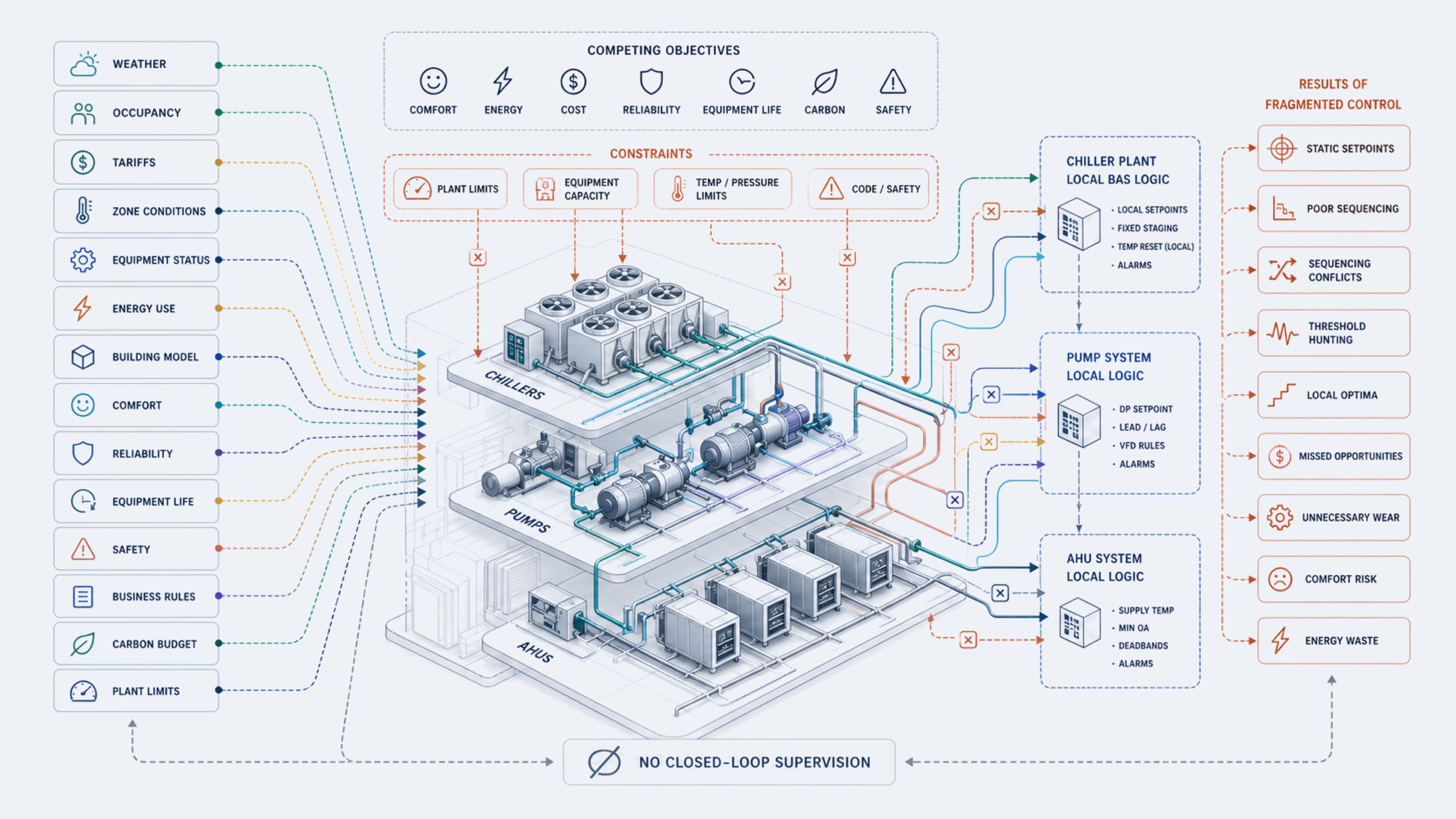
Commercial HVAC is still a massive, under-optimized control problem. Most plants already have BMS visibility, trends, alarms, and operator screens; the persistent waste comes from static setpoints, poor sequencing, and subsystems that are not coordinated through supervised control against real load, weather, and equipment efficiency.

Commercial HVAC plant map showing fragmented local controls, constraints, signals, and under-optimized plant performance.

What we optimize

Plant-wide cooling control

The solution is designed around the operating system you already have in the field, then extended with supervisory logic that can coordinate the assets that matter most.

ClimaMind AI Overlay

A supervisory layer evaluates live conditions and recommends approved central-plant and major air-side setpoints without replacing existing controls.

Optimized HVAC equipment

ClimaMind focuses on the assets that drive plant energy: chillers, pumps, towers, AHUs, PAUs, heat exchangers, boilers, and selected system setpoints.

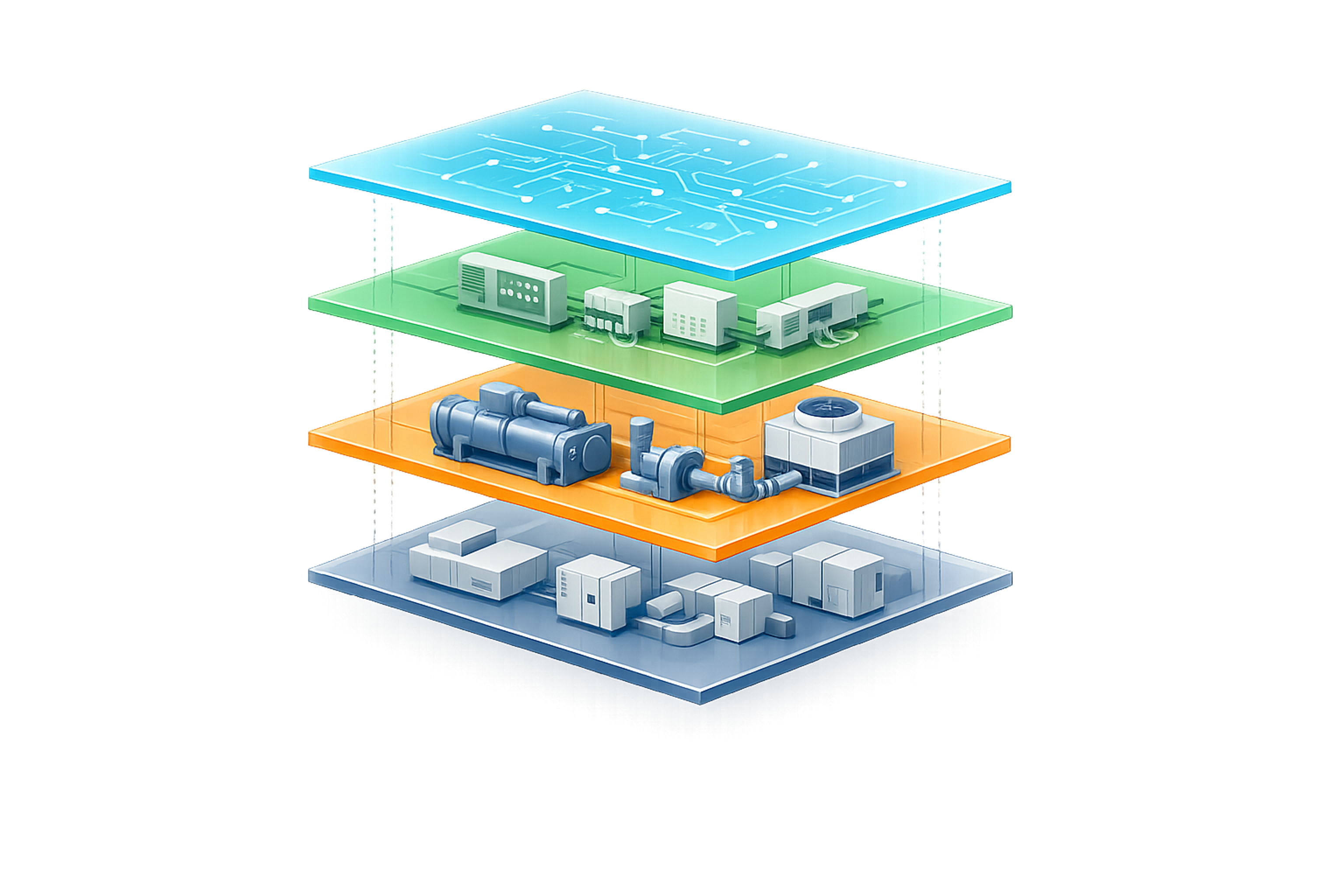
Four-layer ClimaMind AI overlay architecture

Approved Control Access

The BMS remains the operating interface and native control layer. Operators keep visibility, overrides, and local authority.

Non-optimized building systems

Adjacent systems stay outside the optimization boundary unless they are explicitly mapped into the deployment scope.

How savings happen

How ClimaMind saves money

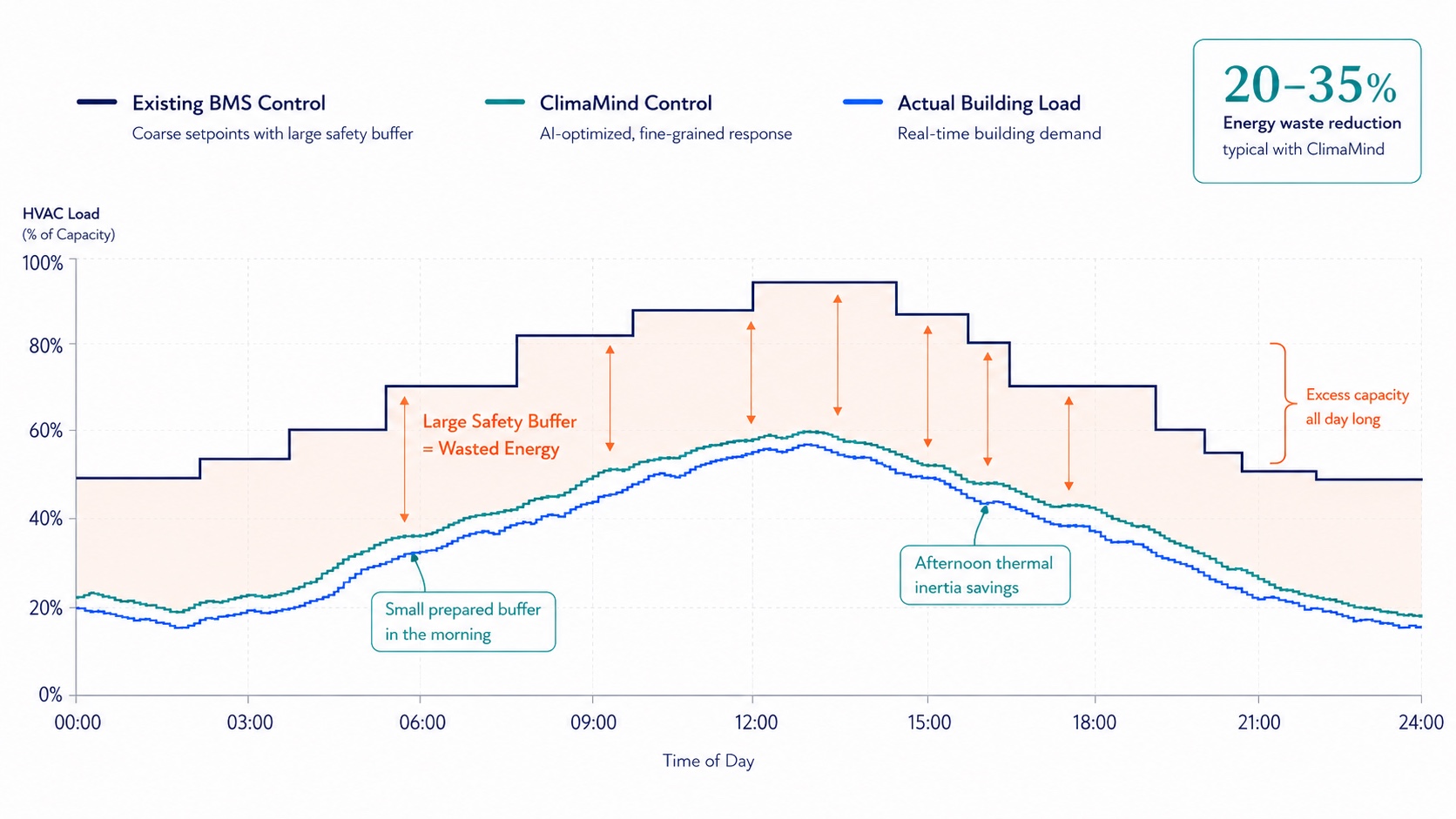
The economic value comes from removing unnecessary operating buffer while making control decisions more precise, bounded, and measurable.

Existing BMS control maintains extra redundancy above actual load while ClimaMind control tracks load with finer adjustments
Mechanism 01

Reduce built-in redundancy

Buildings often run with extra safety margin because schedules and rules are coarse. ClimaMind trims avoidable overcooling, overheating, ventilation, and simultaneous heating/cooling while staying inside comfort and equipment constraints.

Mechanism 02

Control at smaller granularity

Instead of broad settings applied everywhere, ClimaMind adjusts by equipment state, zone demand, time window, weather forecast, and occupancy pattern so each condition receives only the energy it needs.

Mechanism 03

Use thermal flexibility

When the building can coast safely, ClimaMind can reduce runtime or shift load away from costly periods without changing the existing BMS control stack.

Secure intervention

Safety strategy by design

Before AI writes to approved control points, ClimaMind can start in advisory mode, define hard limits, apply bounded tuning steps, and preserve a clear path back to native site control.

Advisory mode

ClimaMind can begin by recommending setpoint changes without writing to live control points.

Hard safety boundaries

Commands outside authorized equipment limits are rejected automatically.

Small-step tuning

Gradual, rate-limited adjustments avoid aggressive transients.

AI/native handoff

Operators can return control to the native site path while fail-hold preserves safe operation.

How value is measured

Audit-ready savings

Measurement fits the site's operating constraints, metering, and commercial boundary so results can be reviewed by operators and sponsors.

The measurement package depends on site conditions, available data, and the agreed commercial boundary.

01

Measurement method

Choose the lightest defensible method for the commercial question: alternating days, a baseline model, or settlement-grade IPMVP when required.

01

Alternating-day comparison

Used where site operations allow a controlled comparison between baseline and optimized operation.

02

Historical or baseline analysis

Used when direct A/B cycling is not practical and the site needs a baseline-based reporting path.

03

IPMVP-alignedM&V

A settlement-grade option for contracts, incentives, financing, or third-party review; requires a pre-agreed M&V Plan and complete data access.

02

What we measure

Once the method is set, the evidence package tracks outcomes, comparable operating conditions, and control traceability.

Metered energy outcome

Plant meters, utility interval data, or BMS energy points define the energy result when they are available.

Utility cost basis

Tariffs, demand charges, time-of-use periods, and billing assumptions translate energy movement into cost impact.

Operating context

Weather, load proxies, schedules, occupancy, and equipment availability explain whether periods are comparable.

Control-log traceability

Keeps the setpoint and operating record available so measured outcomes can be tied back to runtime decisions.

Commercial model

Two ways to work with us

Performance-based pricing is the default. Total HVAC energy-cost share is available when customers need a fixed budget or procurement-friendly structure.

Default

Performance-based savings

Payment aligns to measured savings when the site boundary and reporting data support it.

  • Measurement boundary agreed up front
  • Reporting tied to metering and utility context
Start with performance pricing

Long-term / special requirements

Total HVAC energy-cost share

Available when a total HVAC energy-cost basis fits a long-term customer relationship or procurement requirement better.

  • Fixed budget basis
  • Useful for special procurement constraints
Discuss energy-cost share

Where it fits

Adaptive control for every site

The control layer stays conceptually consistent even when the facilities and operating constraints change.

Office building exterior

Commercial buildings

Central cooling systems serving multi-tenant or comfort-sensitive operations.

University campus exterior

Campuses

Multi-asset environments with varying loads across buildings or thermal loops.

Hospital corridor

Hospitals

Reliability-sensitive environments that need explicit oversight and fallback paths.

Data center

Data centers

Cooling infrastructure where operator control boundaries and measurable outcomes both matter.

Deployment-readiness briefing

Start with your highest-value HVAC energy load.

Review control scope, guardrails, and measurement approach with our team before any closed-loop rollout.