The 2026 DOE Better Buildings and Better Plants Summit made one building-efficiency shift easier to name: the industry is no longer talking about efficiency only as a hardware problem.
Better chillers, heat pumps, motors, drives, envelopes, meters, and sensors still matter. But once those systems are installed, the next question is how the building operates them every hour.
That is where software control becomes a larger opportunity than another round of dashboards.
Hardware gets the building online; operation determines the daily result
Many commercial buildings already have capable mechanical equipment and a working BMS. The energy waste does not always come from broken hardware. It often comes from operating decisions that stay static long after the building has changed.
Setpoints may not move with load. Pump pressure may remain higher than the plant needs. Chiller staging may follow a sequence written for a different tenant mix, weather profile, or equipment condition. Operators may be asked to manage all of this through trend charts, alarms, and manual tuning.
The result is a gap between installed capability and daily performance. Hardware defines what the plant can do. Control software determines what it actually does.
DOE is already framing controls as part of the next efficiency layer
The Summit agenda placed AI, advanced controls, demand management, HVAC, envelope, and storage in the same emerging-technologies conversation. That matters because it puts control logic next to equipment, not behind it as an afterthought.
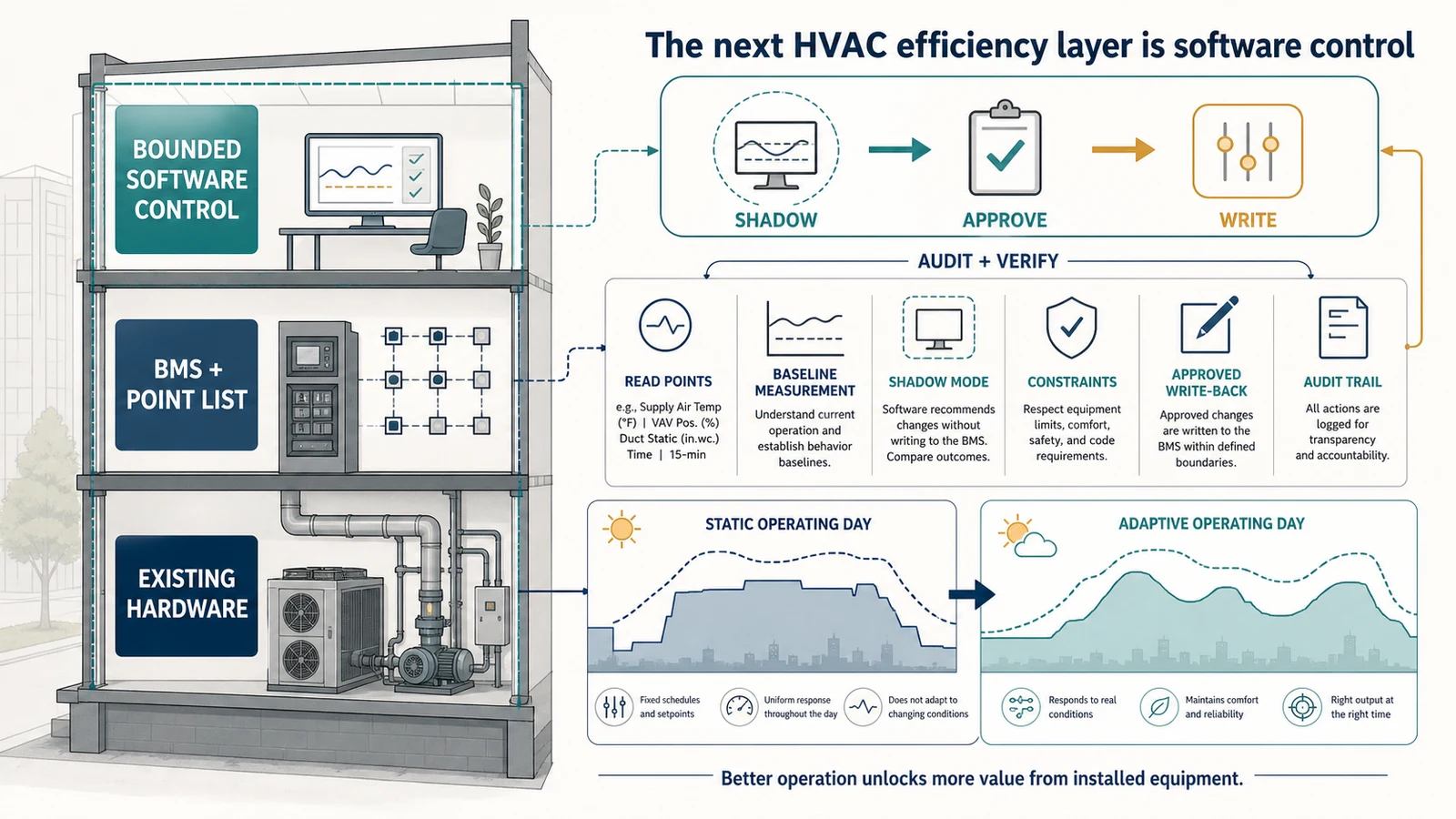
DOE FEMP materials describe Automated System Optimization as supervisory control that sends commands to the BMS. In that framing, the software can continuously adjust setpoints as loads change.
That is the useful distinction. A dashboard can show what happened yesterday. Supervisory control changes what happens next, while staying inside the limits the building team has approved.
AI control is still unfamiliar for a good reason
For many facility teams, AI control still sounds unfamiliar. That reaction is rational. Commercial buildings are not software demos. They are occupied, operational, risk-sensitive environments where comfort, uptime, equipment protection, and operator authority matter.
So the practical question is not whether AI can control a building in the abstract. The better question is whether software can safely operate inside an approved control envelope.
That is a product requirement, not a branding phrase. The system needs to prove that it understands the BMS points, the writable surface, the limits, the rollback path, and the measurement boundary before it earns more control authority.
The point list is where software control becomes real
This is why the BMS point list matters so much. Software control is not real until it can map the actual building: equipment status, temperatures, flows, valve positions, pump speeds, setpoints, alarms, meters, schedules, and operator overrides.
A useful supervisory layer needs to know which points are observable, which are writable, which are advisory-only, which are locked by vendor or site policy, and which are reliable enough to support measurement and verification.
Without that operational surface, AI remains a recommendation layer. With it, the system can begin to move from visibility to bounded action.
What safe software control should include
A software-first HVAC efficiency layer should not replace the BMS or bypass operators. It should make the existing system more valuable by giving it a safer, more adaptive supervisory layer.
The minimum operating requirements are concrete:
- Read BMS points and meter data with units, timestamps, and source context preserved.
- Start in shadow mode when the team needs to inspect proposed actions before write-back.
- Respect comfort, equipment, schedule, and customer-approved control limits.
- Show the reason for every proposed or executed setpoint change.
- Leave an audit trail that supports rollback, operator review, and savings analysis.
- Verify energy impact against a defensible baseline or comparable operating window.
The next efficiency layer is operational
The next big HVAC efficiency opportunity is not only better hardware. It is better software control on top of the hardware buildings already run.
That does not mean full autonomy on day one. It means a supervisory layer that can observe the plant, reason about the operating envelope, propose or execute bounded actions, and connect those actions to measurable results.
For owners, operators, controls contractors, and energy teams, this is the category that matters: not another dashboard, not a BMS replacement, and not an AI black box. A safe way to continuously operate existing building systems better.
Source notes
This article references DOE Better Buildings and Better Plants Summit programming on AI strategies for energy optimization and DOE FEMP guidance on Energy Management Information System capabilities, including Automated System Optimization.
Relevant public sources: https://betterbuildingssolutioncenter.energy.gov/summit-event/smart-savings-ai-strategies-energy-optimization and https://www.energy.gov/femp/energy-management-information-system-capabilities.