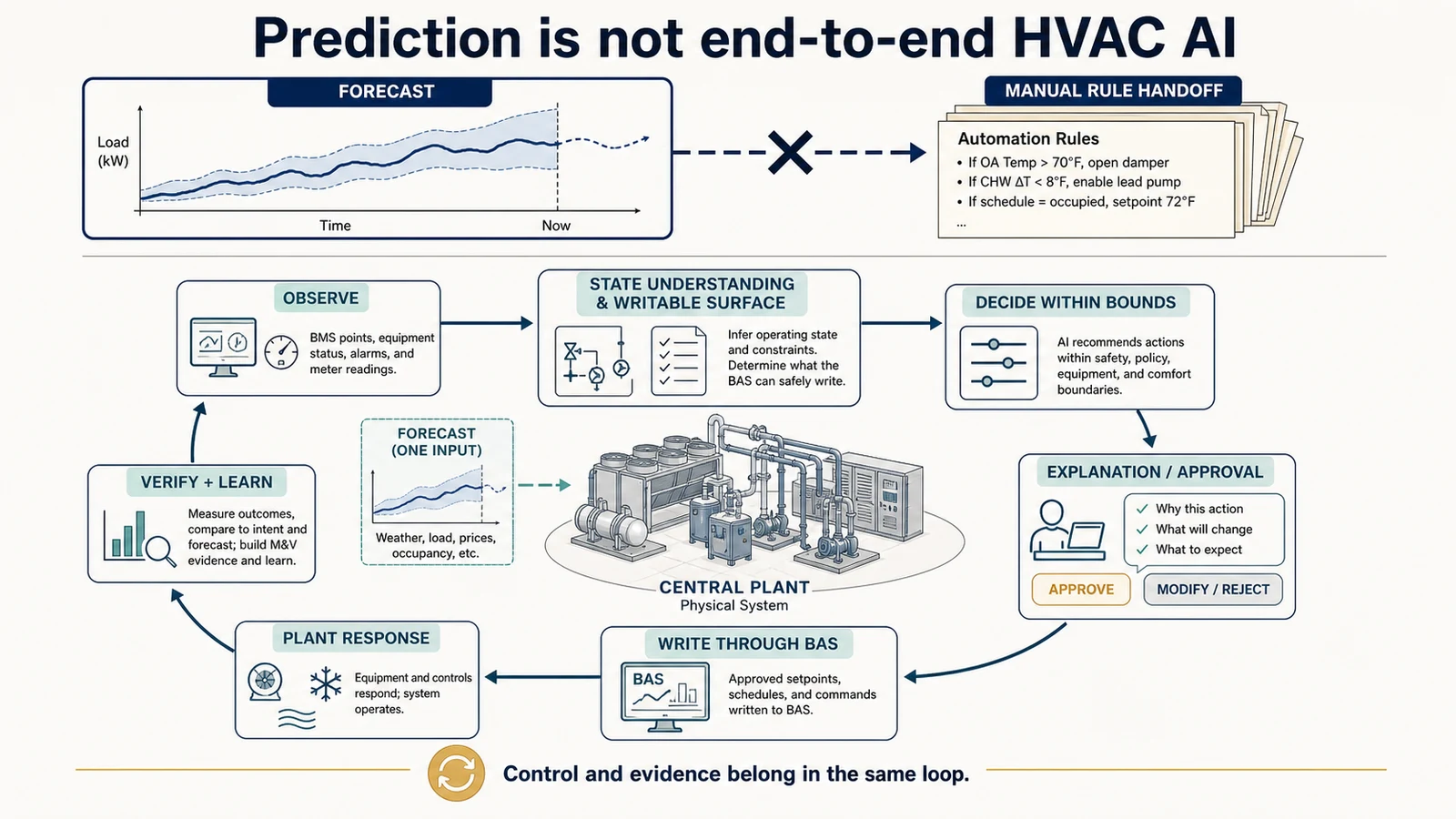
A common pattern in HVAC AI is to start with a time-series model. The system predicts what the building will do, then a separate layer decides what to change, then another layer sends commands to the BMS.
That can be useful. Forecasting temperature, load, occupancy, weather response, or equipment behavior can help a facility team understand what may happen next.
But prediction is not the same as end-to-end optimization.
The harder question is what happens after the forecast
For a central plant, the forecast is only one piece of the control problem. The system still has to decide which action should be taken, which constraints make that action acceptable, which operating mode the building is actually in, and which BMS point can be written safely.
It also has to know which operator-approved envelope applies, what to do when the action conflicts with comfort or equipment protection, and how the result will be measured afterward.
If AI stops at prediction and the rest of the stack becomes hand-authored automation logic, the system is not really AI-in-the-loop. It is prediction in front of automation.
Buildings are not only time-series problems
Commercial buildings are control systems with physical constraints, messy BMS point maps, local sequences, operator preferences, equipment limits, override behavior, and measurement requirements.
The state of the building is not just the next value in a trend. It is a combination of load, equipment availability, writable control surface, operating mode, comfort boundary, maintenance state, and the authority the facility team has granted to the supervisory layer.
A useful HVAC AI architecture has to reason across those pieces together, because the control decision depends on all of them.
End-to-end means AI stays in the control loop
An end-to-end HVAC AI system should treat observation, decision, control, and verification as one connected loop. The BMS data, control envelope, operator workflow, write-back path, and measurement evidence are not separate afterthoughts.
The loop should be explicit:
- Observe the building through BMS and meter data.
- Understand the operating state and current control surface.
- Choose a control action that fits the approved envelope.
- Explain why the action is being proposed or executed.
- Write back through the existing BMS only where permitted.
- Watch the result and update future decisions.
- Preserve the evidence needed for M&V and operator review.
Control and evidence should not be bolted on later
This is the architecture distinction that matters. The control decision should not be bolted on after the model. The measurement path should not be bolted on after the pilot. The operator workflow should not be bolted on after deployment.
Those pieces are all part of the optimization problem. If they are handled as separate manual rules, the product may still automate actions, but it is not treating HVAC optimization as one closed system.
For facility teams, that difference is practical. They need to see the proposed action, the boundary, the reason, the override path, and the outcome evidence. A forecast alone cannot provide that operating record.
The goal is measurable control, not prediction in isolation
At ClimaMind, the product line we care about is AI-in-the-loop from data to decision to control to verification.
That does not mean replacing the BMS, bypassing operators, or hiding behind autonomous commands. It means using AI as part of the full supervisory control path: sensing the building, selecting bounded actions, explaining them, executing through the existing BMS, and tying the result back to savings evidence.
The goal is not to predict the building better in isolation. The goal is to change how the building operates, safely, visibly, and measurably.