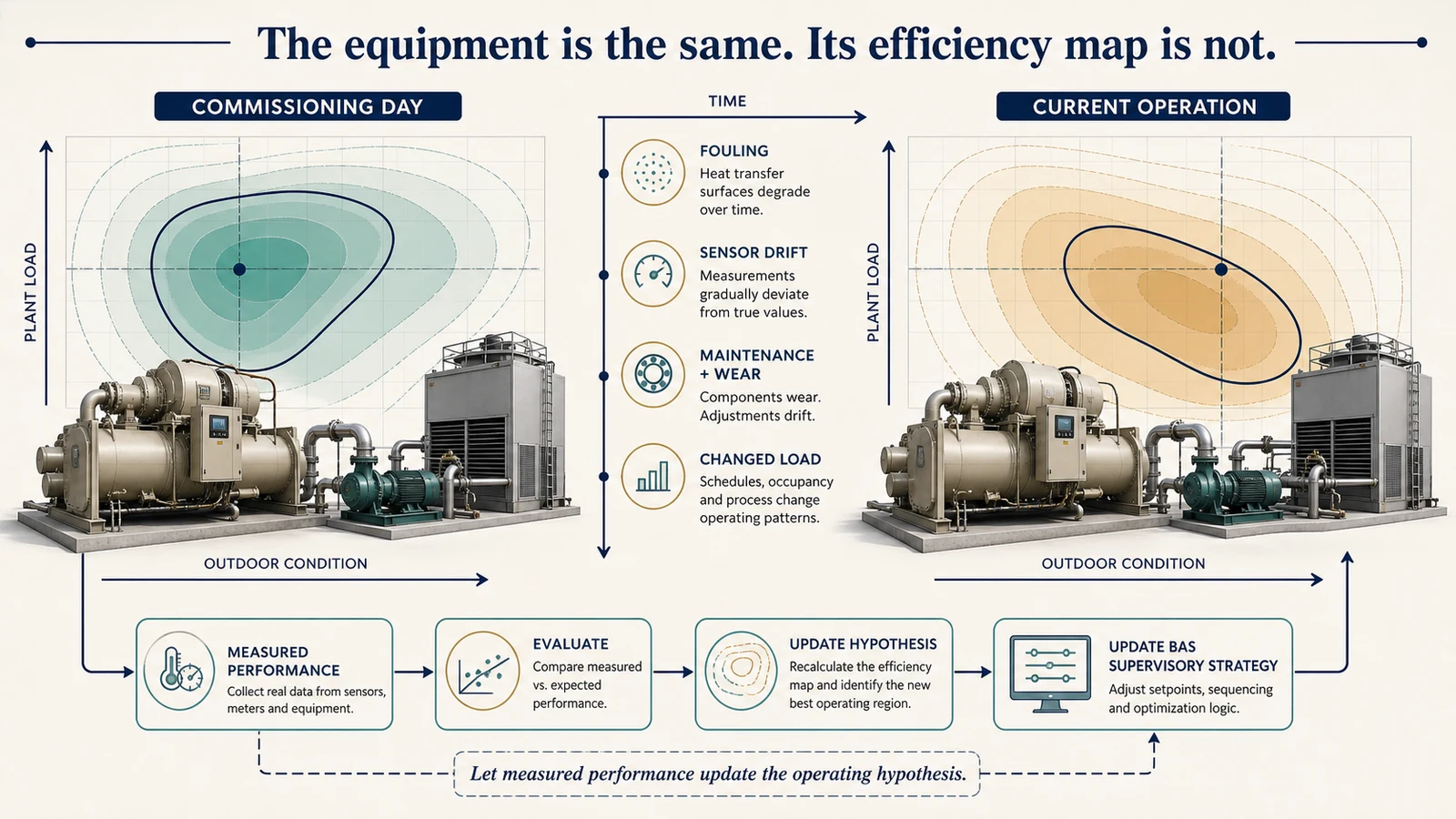
A central plant can look unchanged for years. The chillers, pumps, cooling towers, piping, and BMS sequence may all carry the same names they had at commissioning.
But the plant the original sequence described no longer exists. Its equipment has accumulated operating hours, maintenance interventions, sensor error, fouling, and different load conditions. The hardware may be recognizable while the relationship between load, flow, lift, power, and efficiency has shifted.
That matters because many supervisory decisions still depend on assumptions established when the plant was newer.
Equipment performance changes even when the asset list does not
An equipment schedule tells us what is installed. It does not prove how each machine performs today across the full operating range.
Several ordinary changes can move the real efficiency map without creating an obvious equipment failure:
- Heat exchangers foul and change heat-transfer performance.
- Sensors drift and change what the control sequence believes.
- Pump, fan, and chiller performance shifts with wear and maintenance.
- Actual loads move away from the conditions used during commissioning.
A correct commissioning decision is not a permanent fact
A lead chiller may have been the most efficient first-stage choice when the sequence was written. A chilled-water reset curve may have matched the original coils, flows, and load profile. A condenser-water rule may have represented a reasonable balance between tower fan energy and chiller lift.
Those decisions were not necessarily wrong. The problem begins when a historical operating conclusion is treated as a permanent property of the plant.
Periodic retuning can update the answer, but it still produces another snapshot. The plant continues to change after the commissioning engineer leaves.
Use measured performance to keep testing the operating hypothesis
A supervisory optimization layer can use measured plant performance to evaluate whether approved staging and reset decisions still make sense under current conditions.
That evaluation should compare total plant response, not only the apparent efficiency of one component. A lower condenser-water temperature may reduce chiller lift while increasing tower fan power. A pump speed change may reduce pumping energy while changing valve authority, flow, or comfort risk. A different chiller combination may perform better at one load and worse at another.
The useful efficiency map is therefore an operating model grounded in meter data, BMS trends, equipment status, weather, load, control commands, and the conditions under which each result was observed.
Adaptation still needs a visible BMS control envelope
Measured adaptation does not mean bypassing the existing control architecture. The BMS remains the system of record for local loops, safeties, interlocks, alarms, schedules, approved setpoint limits, and operator override.
The supervisory layer should work only through site-approved decisions such as chiller staging preferences, chilled-water and condenser-water temperature resets, or pump and tower supervisory setpoints. Every action should be logged, bounded, reversible, and relinquished when the approved conditions no longer hold.
Operators should be able to see what changed, why it changed, and whether the expected plant response actually occurred.
The current plant should determine the current strategy
A durable optimization program does not assume that commissioning data, nameplate curves, or last year's preferred equipment order remain true forever.
It measures the current plant, separates genuine performance change from sensor or operating-mode problems, and updates decisions only inside an agreed control and measurement boundary.
The equipment may be the same. Its performance is not. The control strategy should be able to recognize the difference without taking authority away from the people and systems responsible for safe operation.
A control sequence ages because the equipment it describes keeps changing.