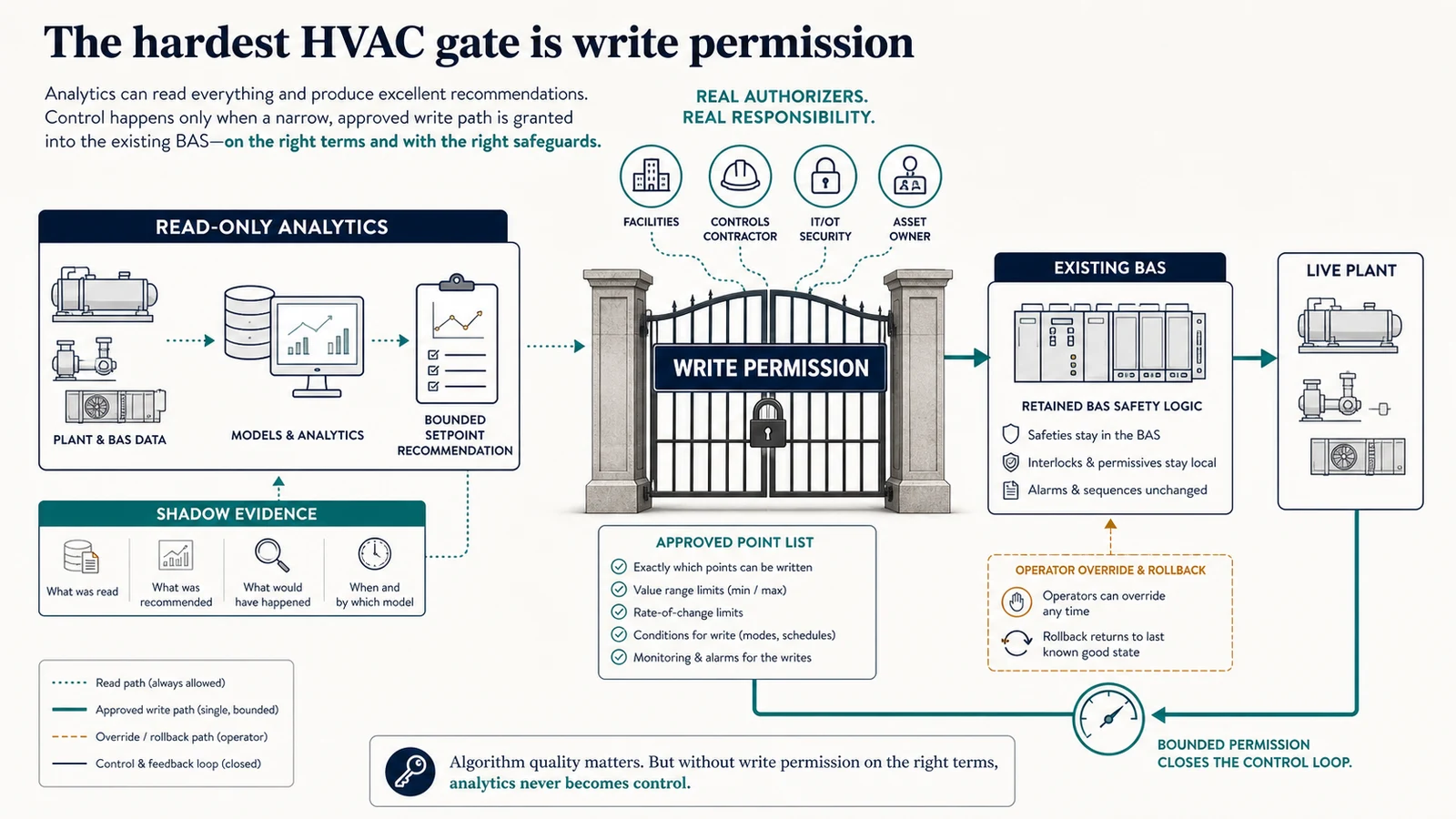
The hardest gate in HVAC optimization is write permission, not algorithm quality.
In software conversations, the focus is usually on the model: better prediction, better sequencing, better setpoint logic, better optimization.
In a real building, the harder question is simpler: are we allowed to change this point?
That question stops more projects than weak algorithms.
Read-only integration often ends as analytics
A central plant may have years of trend data, a capable BMS, and obvious efficiency gaps.
But if the optimization layer can only read points and cannot write approved setpoints back through the BAS, the project often ends as analytics.
Not because the opportunity is fake. Because the control loop never closes.
A system connects, reads temperatures, flows, powers, and statuses, finds better operating points, and shows what it would have changed. Then nothing happens automatically.
The recommendations go into a report, a dashboard, or an operator queue. The plant keeps running the old way.
Write authority is spread across the building
Write permission matters more than people admit because the people who want savings are not always the people who can authorize BAS changes.
- The facility team may want savings, but the controls contractor may be the only party trusted to touch the BMS.
- IT/OT may restrict third-party write access by default.
- The BMS vendor may prefer analytics inside their own platform.
- The asset owner may approve a pilot, but not approve live control changes.
- The energy team may see the opportunity, while the person with write authority sees the risk.
The advisory-only pattern is familiar
None of these reactions are irrational. They are the normal governance of a live building.
But they create a familiar pattern. The vendor calls it AI optimization. The building team experiences it as another advisory tool.
That gap is not solved by a better neural network. It is solved by earning bounded write permission inside an approved control envelope.
Define the control surface before asking for trust
Before live write-back, the building needs a concrete answer to questions like:
- Which setpoints can be changed?
- Who approves that list?
- Which points must remain advisory only?
- What BAS safety logic stays in force?
- What happens if the operator overrides or rolls back?
- How will the result be measured after control begins?
Shadow mode turns permission into an operational decision
This is also why shadow mode matters. Before asking for live write-back, a supervisory system should show which point it would adjust, why that adjustment made sense, which constraint allowed it, and what it expected to happen afterward.
That turns write permission from a vague IT objection into a concrete operational decision.
Not trust our AI, but do you approve this control surface?
Design around the gate from the beginning
At ClimaMind, we think HVAC optimization has to be designed around that gate from the beginning.
Read the plant first. Make the control logic inspectable. Earn permission for bounded write-back. Then optimize inside the approved envelope.
In commercial buildings, the systems that actually change energy bills are not the ones with the most impressive model.
They are the ones allowed to act safely on the BAS the building already trusts.