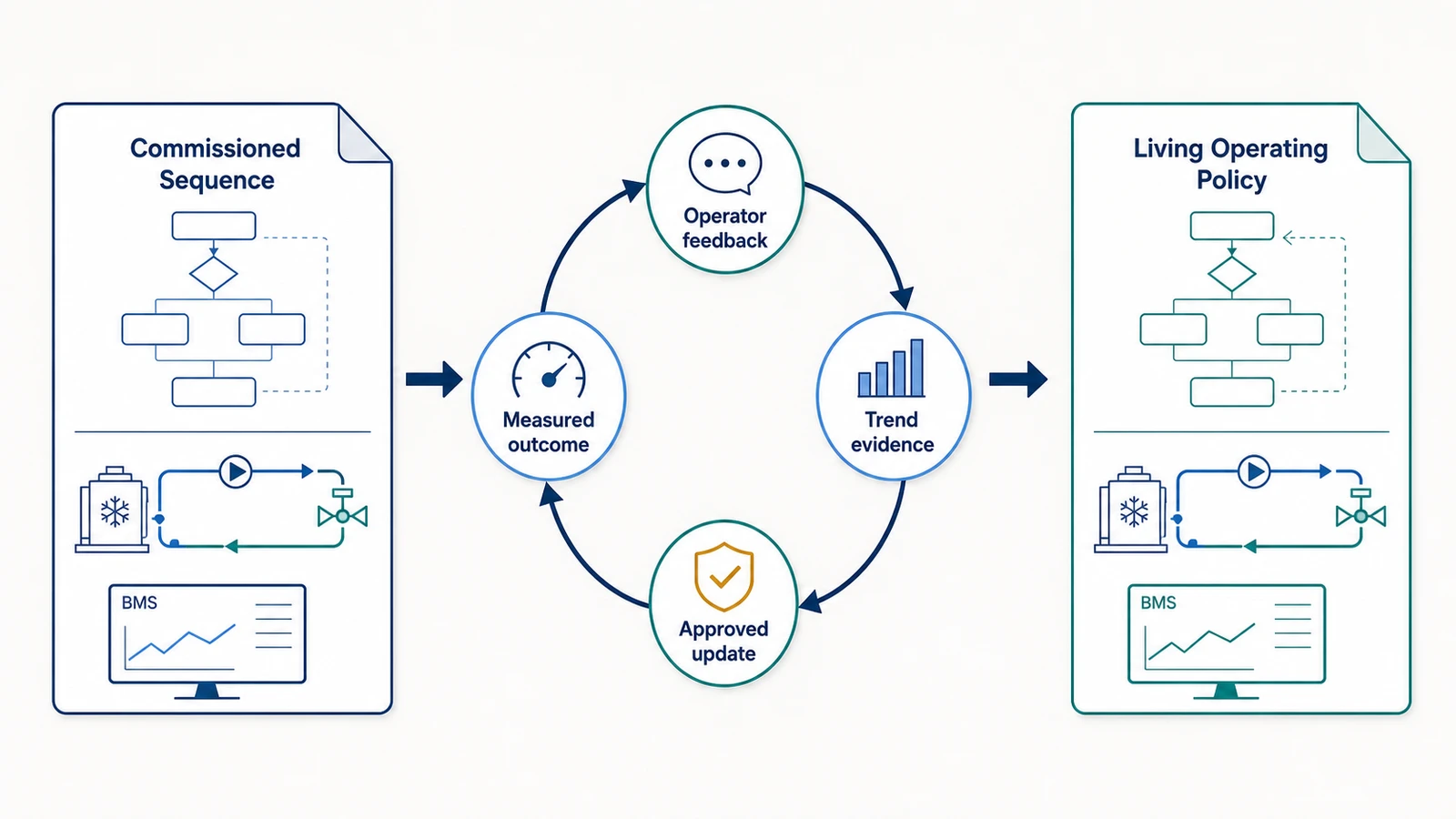
A sequence of operation is often treated as the final document from commissioning.
In a real building, it is closer to the first approved version of an operating policy.
The equipment changes. Loads change. Occupancy, weather, maintenance conditions, tenant needs, utility tariffs, and operator priorities all change too.
The sequence should be able to respond without losing the discipline that made it safe in the first place.
The building does not stop changing after commissioning
A commissioning sequence establishes an important baseline. It defines how equipment should stage, reset, respond to alarms, and protect comfort and equipment.
But it is written at a moment in time.
Six months later, a floor may have a different occupancy pattern. A cooling tower may perform differently. A maintenance issue may force a temporary operating mode. A schedule may be changed to solve a real comfort problem.
Those changes do not automatically mean the original sequence was wrong. They mean the operating policy needs a way to distinguish between a temporary exception, a newly necessary constraint, and a change that should be reviewed before it becomes permanent.
A point value is not an operating decision
The BMS can show the current setpoint, command, alarm state, and schedule. What it often cannot show on its own is the decision behind them.
- Is a tighter chilled-water reset limit an approved strategy or a response to one complaint?
- Is an equipment mode still required, or did it remain after maintenance?
- Does a schedule reflect current occupancy, or an old special event?
- Did a change improve the result it was meant to improve?
Without that context, a building can preserve every value while losing the operating intent that connects those values into a coherent sequence.
Treat sequence changes as controlled policy updates
This does not require a formal redesign every time an operator makes an adjustment. It requires a lightweight lifecycle for changes that materially affect energy, comfort, equipment, or operating risk.
- State the reason and owner for the change.
- Identify whether it is temporary, seasonal, or intended as a permanent update.
- Set a review date or an explicit condition for reversal.
- Keep the approved control envelope visible to operators and service providers.
- Compare the outcome with the condition that justified the change.
That creates a useful distinction: the BMS remains the system of record for local control and protective logic, while the operating policy records why the site is being asked to run a particular way.
Supervisory control should support policy discipline
A supervisory optimization layer should not treat a sequence as a static collection of writable points. Its job is to work inside an approved operating envelope and make the consequences of change easier to see.
It can connect trend evidence, operator feedback, temporary exceptions, and measured outcomes. It can show when a control change has drifted from its stated purpose. And it can surface where a recurring exception may be evidence that the operating policy itself needs review.
That is a more practical use of AI in building operations: not to bypass the people and sequences that keep the building safe, but to help them keep the sequence current, explainable, and accountable.
The goal is deliberate evolution
The answer is not to freeze the commissioning document forever. Nor is it to let daily workarounds become the real sequence by accident.
The goal is a living policy: stable enough to protect the building, visible enough for operators to trust, and responsive enough to improve as operating evidence accumulates.
A high-performing HVAC sequence is not the one that never changes. It is the one whose changes remain intentional.