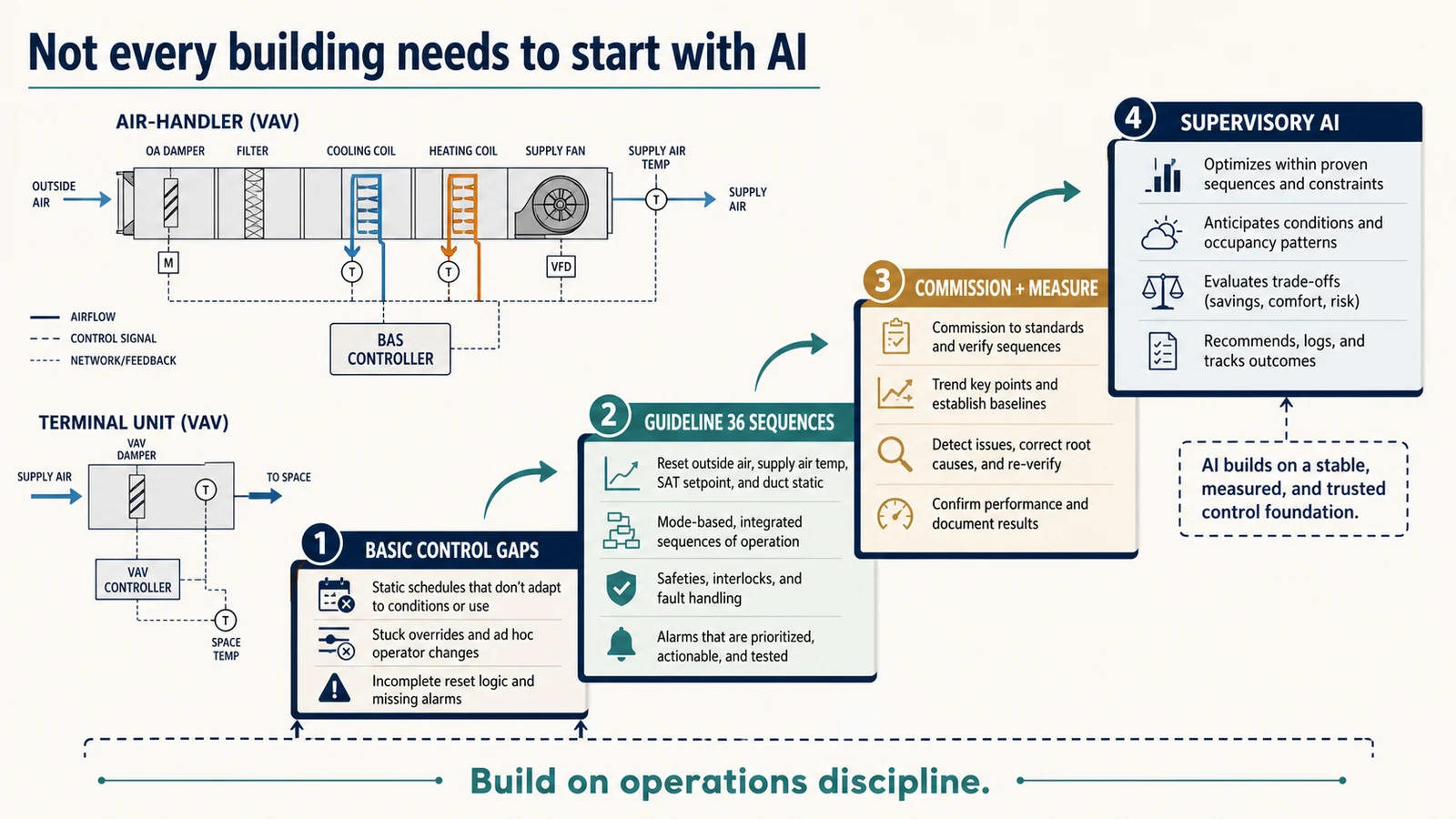
Not every building needs to start with AI.
In many HVAC systems, current operation is still far from anything close to optimal.
The practical question is not always whether the facility team is ready for autonomous supervisory control. Sometimes the first question is whether the building is already running a good modern sequence at all.
A better first question
For many buildings, the lower-risk starting point is simple: are we running a good modern control sequence?
ASHRAE Guideline 36 is useful because it gives the industry a clearer language for high-performance sequences of operation, especially for systems like VAV air handlers and terminal units.
That does not make it a magic button. It still needs commissioning, site-specific judgment, BMS access, operator review, and measurement and verification.
Many systems still have basic control gaps
A building can have a modern BMS and still operate far below its practical control potential.
The problem is often not the absence of AI. It is that the control sequence, trend evidence, operator intent, and measurement path are not explicit enough.
- Static schedules and setpoints that no longer match the building.
- Reset logic that was never fully commissioned.
- Local overrides that solved one issue and then stayed in place.
- Control sequences that depend on vendor defaults or one-off tuning.
- Limited measurement of whether a control change actually helped.
Guideline 36 is a practical first step
If a team is not ready to go all in on AI-based supervisory control, that is understandable.
Start with better sequences. Start with the BMS points that are already available. Start by making resets, limits, schedules, overrides, and operator intent more explicit.
Then measure what changed. That path can improve operation today while making future optimization safer.
Clearer sequences make supervisory control safer
Once the operating envelope is clearer, a supervisory layer can do more useful work.
It can observe how the building behaves, recommend changes inside approved constraints, keep operators in the loop, write only where permissions allow it, leave an audit trail, and verify savings afterward.
That is the progression ClimaMind is building toward: better control sequences first, transparent BMS integration next, and safe supervisory optimization where the building and the team are ready for it.
AI should build on operations discipline
AI should not be a shortcut around building operations discipline.
The better path is to make the existing control problem clearer, use industry control-sequence practice where it fits, and then apply supervisory optimization inside a visible and measured operating envelope.
For many buildings, that means the first move is not all-in AI. It is a better sequence, better BMS visibility, and better measurement.
AI should build on building operations discipline, not shortcut around it.