Most facility teams already believe there is waste in the HVAC system.
They know setpoints drift, schedules get stale, and pumps, towers, chillers, and air handlers often run more conservatively than needed.
They also know the energy bill could be lower. So the hard part is usually not convincing them that savings exist.
The harder question is who carries the risk
The harder question is simple: Who carries the risk if the control action is wrong?
If an AI system recommends a chilled water reset, condenser water change, pump differential pressure adjustment, or staging decision, the facility team has to think beyond the energy model.
They have to think about comfort complaints, equipment protection, tenant experience, maintenance state, BAS permissions, override behavior, IT/OT approval, after-hours escalation, and whether the savings can be verified later.
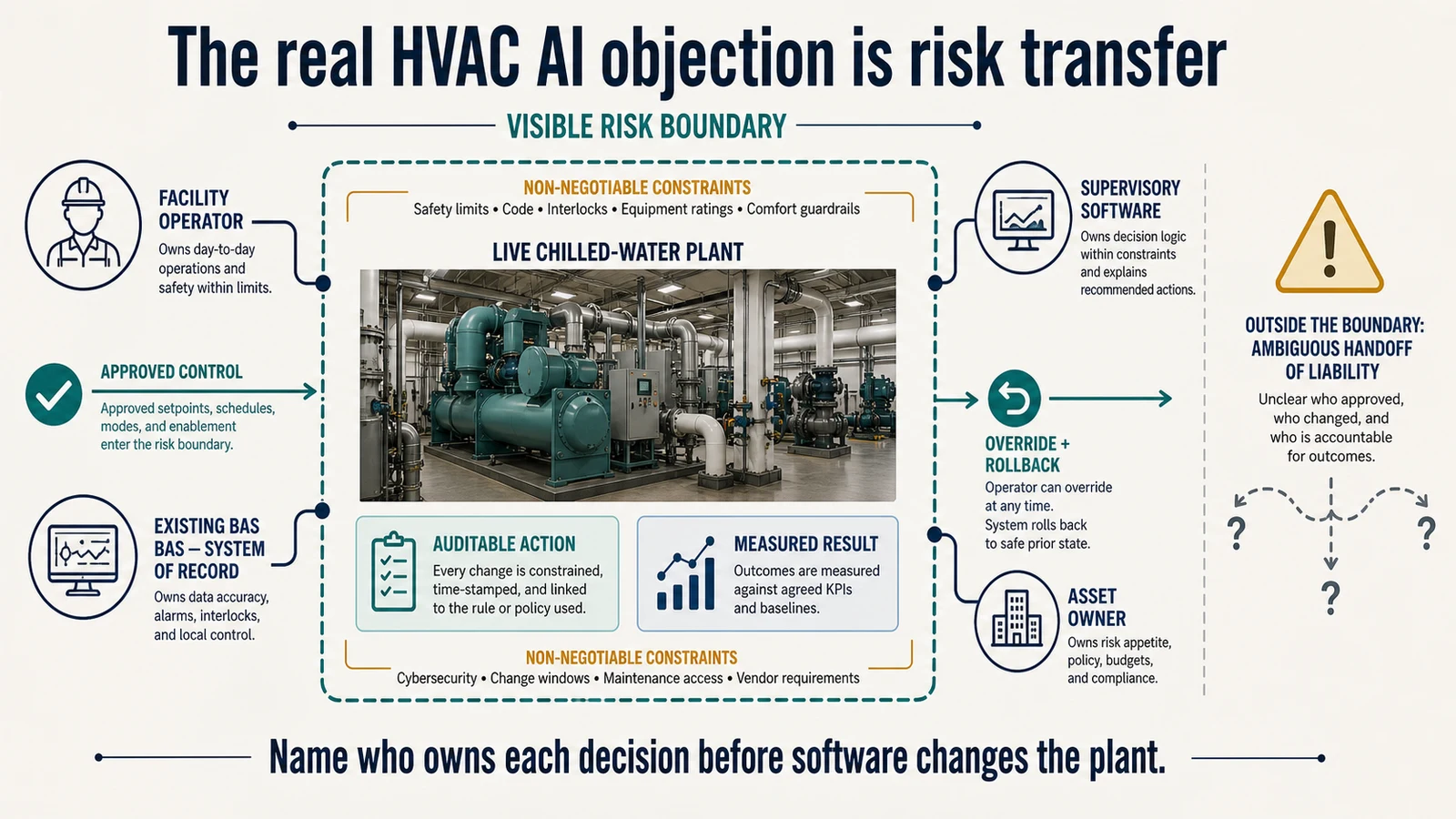
The risk boundary has to be explicit
That is why HVAC AI cannot be sold only as an efficiency tool. It has to be sold as an accountable control system.
A serious supervisory control product should make the risk boundary clear before live control begins.
- What the system can observe.
- What the system can write.
- Which actions remain advisory only.
- Which constraints are non-negotiable.
- Who approves the control envelope.
- How the operator overrides or rolls back.
- What evidence is preserved after each action.
- How the result will be measured.
The BAS remains the system of record
Without that boundary, the product asks the building team to absorb the operational risk while the software vendor claims the savings upside.
A better model keeps authority with the facility team. The BAS remains the system of record for local control, safeties, schedules, alarms, trend logs, and operator override.
The supervisory layer should act only inside an approved envelope, with every action visible, explainable, reversible, and measurable.
Operator trust is not liability transfer
Do not ask operators to trust an AI black box. Do not ask them to manually absorb every machine-speed decision. Do not turn human in the loop into liability transfer.
Build the control envelope first. Earn permission inside it. Measure the outcome afterward.
The vendor has to be accountable for the decisions made inside that boundary, while the building team keeps authority over the mission, constraints, and override.
The sales conversation should name accountability
The real objection is not whether HVAC AI can save energy in theory.
The real objection is whether the building team can trust the system without inheriting unmanaged operational risk.
That is the question an HVAC optimization product has to answer before it earns write permission.
Can we trust the system without inheriting unmanaged risk?