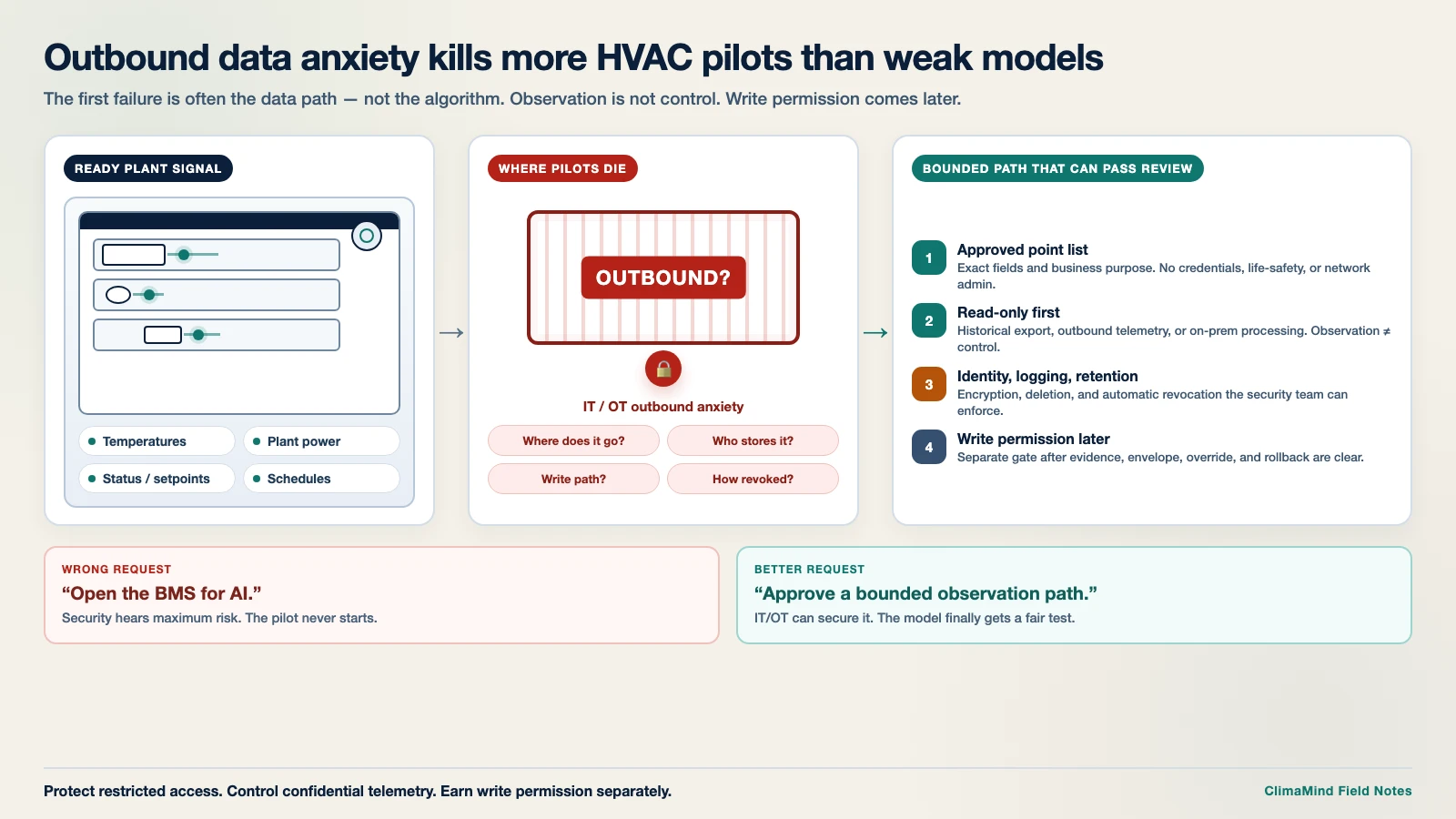
Many HVAC optimization pilots do not fail because the model is weak.
They fail earlier, when the site cannot approve a path for operating data to leave the local control environment.
The facility team may already see static setpoints, poor staging, or loose plant coordination. Energy has a reason to act. The algorithm may even look ready on paper.
Then the pilot meets outbound data anxiety.
The real blocker is often the data path
In live buildings, the hard conversation is rarely "is reinforcement learning better than a rule curve?"
It is closer to:
- Where does this data go?
- Who can store it?
- How long is it retained?
- What network path carries it?
- Does this create a write path into the BMS?
- What happens if the vendor connection fails or is revoked?
Those questions are rational. Building automation is operational technology. A careless outbound feed can create real security and operational risk.
But when every data request is treated as an open door to the plant, the project never gets far enough to prove savings, operator workflow, or control quality.
The result is familiar: interest, a security review, delay, and a quiet return to analytics-only tools.
Model quality is not the first decision
Model quality matters later. First the site has to decide whether a bounded observation path can exist at all.
Without approved telemetry, there is no durable baseline. Without a baseline, there is no credible measurement path. Without measurement, there is no honest pilot. Without a pilot, the organization never gets evidence that would justify later write permission.
That is why outbound data anxiety can kill more projects than weak models. The model never gets a fair operating test.
A plant can have messy trends, incomplete points, and imperfect sensors and still be useful for a first review. What it cannot do is support closed-loop optimization while every useful operating record remains trapped behind a blanket prohibition on leaving the local network.
Separate leaving the building from controlling the building
Outbound data access and control authority are different decisions.
A first pilot stage may need only an approved point list: temperatures, flows, statuses, setpoints, schedules, and plant power where available. That can begin as a time-bounded historical export or a continuous read-only feed. It does not require administrative BMS access. It does not require write permission. It does not require the BMS to sit on the public internet.
Write-back is a later gate. It needs its own envelope: which setpoints may change, which limits stay fixed, how operators override or roll back, and how actions are logged against measured results.
When those stages are collapsed into one request—"connect AI to our BMS"—security teams hear the largest possible risk, and energy teams lose the smallest useful first step.
Give IT and OT a request they can secure
The wrong request is: open the BMS for AI.
The better request is a documented data path:
- Exact points and business purpose.
- Read-only first, with write authority excluded unless separately approved.
- Preferred handling mode: historical export, outbound read-only telemetry, or on-premises processing where required.
- Identity, encryption, logging, retention, deletion, and revocation.
- No credentials, life-safety systems, access-control records, or network administration in the initial scope.
- A clear statement that observation does not imply control.
This is not a way around security. It is the only way security can make a precise decision.
Some sites will still require processing to stay local. That is a design input, not automatically a project rejection. The architecture should adapt to the site's residual risk posture instead of pretending every building can accept the same cloud path on day one.
Anxiety is reduced by boundaries, not by bigger claims
Outbound anxiety does not go away because a vendor promises higher savings.
It goes away when the site can see a narrow path:
- approved data only;
- stated retention;
- reversible access;
- operator visibility;
- later write permission as a separate earned decision;
- measurement that can explain what changed and what did not.
At ClimaMind, we treat that path as part of the product, not as a procurement inconvenience. Supervisory optimization only becomes useful after the building can share the operating evidence needed to evaluate it, and only becomes trustworthy after control remains bounded by the existing BMS and the people responsible for the plant.
If a pilot dies before any model is tested, do not start by asking whether the algorithm was good enough.
Ask whether the organization ever defined a data path that IT, OT, and facility operations could all live with.