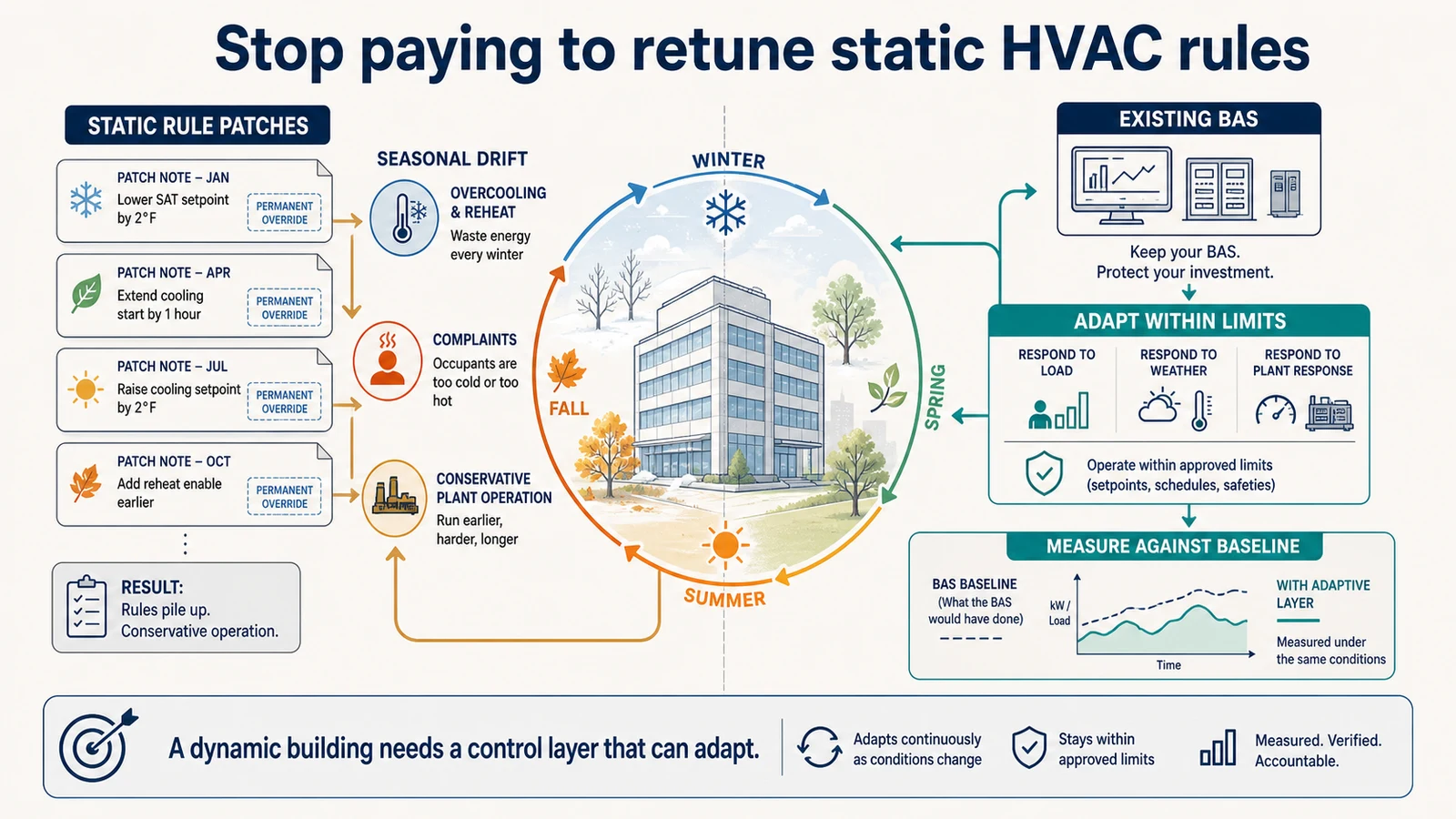
If your building is always too hot in one area and too cold in another, the problem is usually not a lack of dashboards.
It is often a control problem. The BMS may be installed, the equipment may be capable, and the facility team may already be doing the best it can.
But the building may still be running on static rules written for a version of the building that no longer exists.
Static rules start fighting dynamic buildings
Loads change. Weather changes. Tenants change. Schedules change. Equipment performance changes.
When the rules do not keep up, the symptoms are familiar to operators and owners.
- Hot and cold complaints across the same building.
- Overcooling in one zone and reheating in another.
- Seasonal retuning that never seems to hold.
- Operators overriding setpoints to keep people comfortable.
- Pumps, towers, and chillers running more conservatively than needed.
Retuning can help, but it is still static
The traditional answer is to bring people back in and retune the static BMS rules.
That can help, especially when the current sequence is clearly wrong. But it is still a static answer to a dynamic problem.
If a building is already spending time and money rewriting HVAC rules, the better question is whether that budget should move directly toward AI supervisory control.
AI supervisory control keeps the BMS in place
ClimaMind does not replace the BMS. It sits above the existing BMS and continuously adjusts approved supervisory decisions such as setpoints, resets, staging, and plant coordination.
The BMS remains the system of record. The operator keeps authority. The control envelope stays visible.
The difference is that the optimization layer is no longer limited to rules someone has to manually rewrite every season.
The savings baseline matters
Qualified sites can reduce HVAC energy use by up to 25%, but ClimaMind does not treat that public upper bound as a blanket promise. The opportunity has to be qualified against the building's own BMS baseline, controllable points, meter data, and operating constraints.
If a building already has visible control conflict, frequent comfort complaints, or constant manual retuning, the savings opportunity can be larger than a well-tuned baseline. If the current operation is already tight, the opportunity may be smaller.
That upside should not be guessed. It should be measured from BMS trend data, control points, meter data, and pilot results before it becomes a savings claim.
Use the retuning budget for a better control layer
If an HVAC system keeps needing static rule tuning, do not just buy another round of static rules.
Use that budget to move toward a control layer that can keep adapting: better result, lower disruption, lower cost than heavy retrofit, and a cleaner path from operational pain to verified savings.
The goal is not to remove the BMS. It is to stop depending on static rules to manage a dynamic building.
Stop depending on static rules to manage a dynamic building.