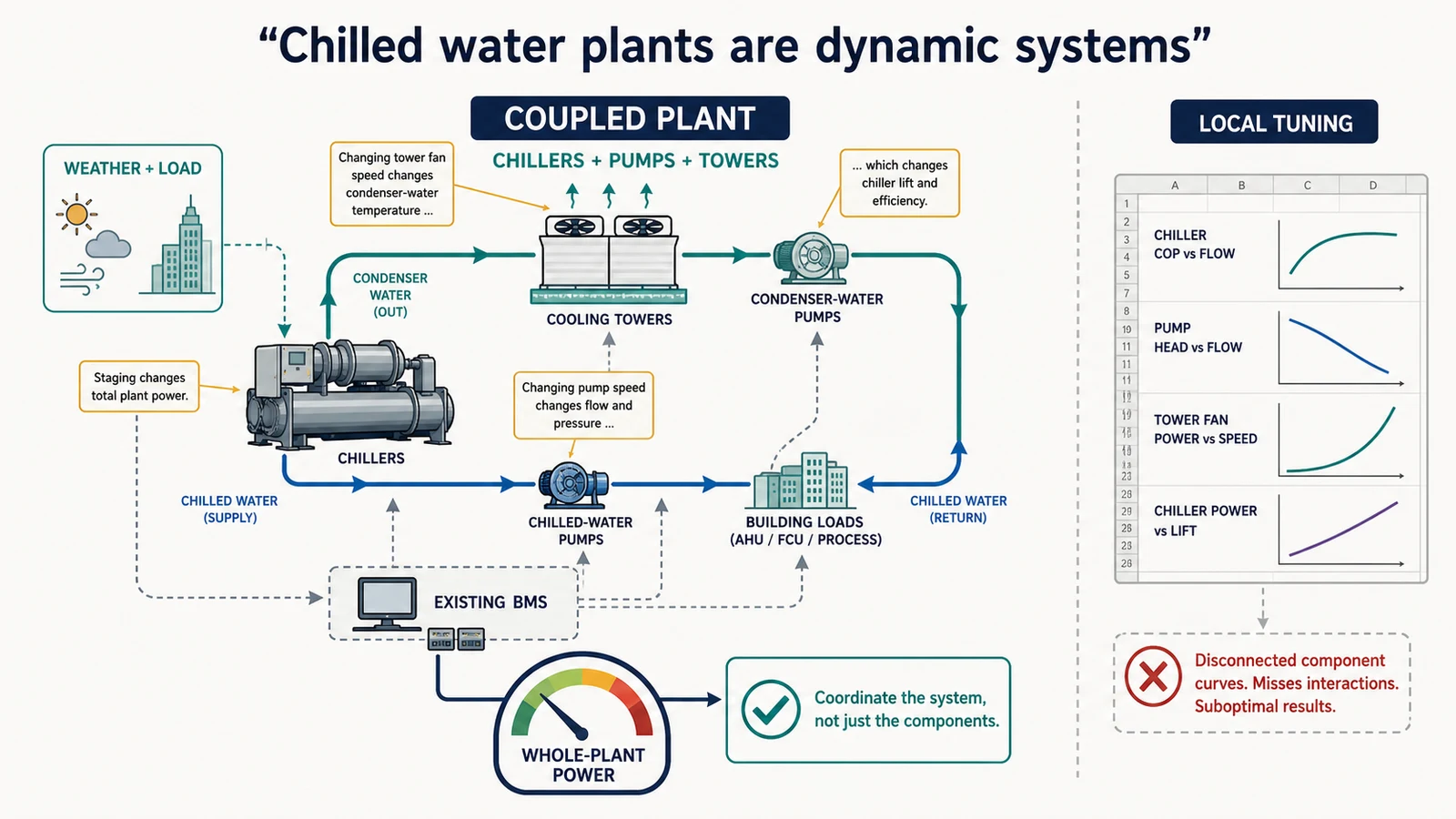
Many chilled water plants are still optimized one component at a time.
A chiller curve is reviewed. A pump schedule is adjusted. A cooling tower setpoint is tuned. Trend logs are exported into a spreadsheet.
That work can be useful, but it often misses the real problem. A chilled water plant is not a set of independent assets. It is a dynamic system.
The plant does not operate one device at a time
Each local decision changes the conditions seen by the rest of the plant. A control move that looks efficient for one component can be inefficient once the full plant interaction is considered.
That is why central plant optimization has to account for the coupled behavior of chillers, pumps, towers, weather, load, BMS sequences, and operator constraints.
- Chillers depend on condenser water temperature, return water temperature, part-load ratio, staging, flow, weather, and building load.
- Pump decisions change flow, valve behavior, distribution pressure, and the conditions seen by the rest of the plant.
- Cooling tower strategy changes fan energy, condenser water temperature, and chiller lift at the same time.
Local efficiency can hide system waste
Lower tower fan energy can increase chiller lift. Lower pump speed can create comfort or flow risk. A conservative setpoint can protect operations while wasting energy every hour.
The question is not whether one component looked efficient in isolation. The question is whether the plant made the right coordinated decision under the current load, weather, equipment state, comfort boundary, and approved BMS control envelope.
Trend review explains the past. Control changes the next interval.
Trend analysis can show what happened. A spreadsheet can compare operating points. Static rules can encode a better sequence for a known condition.
But the harder question is what the plant should do next. That is a control question, not only an analytics question.
For a dynamic chilled water plant, the useful answer has to be bounded by comfort, equipment protection, BMS permissions, maintenance state, operator authority, and the measurement path used to verify the result.
Supervisory control coordinates the system
At ClimaMind, we think chilled water optimization should move from periodic tuning to supervisory control.
That does not mean replacing the BMS or bypassing operators. It means sitting above the existing BMS, understanding the plant as an interacting system, and recommending or executing bounded control actions inside an approved operating envelope.
Every action should remain visible, explainable, reversible, and measurable. The operator should keep authority. The BMS should remain the system of record. The optimization layer should help the plant coordinate itself better than static tuning can.
The biggest savings usually do not come from optimizing one component in isolation. They come from coordinating the system.
The bigger opportunity is coordinating the system.