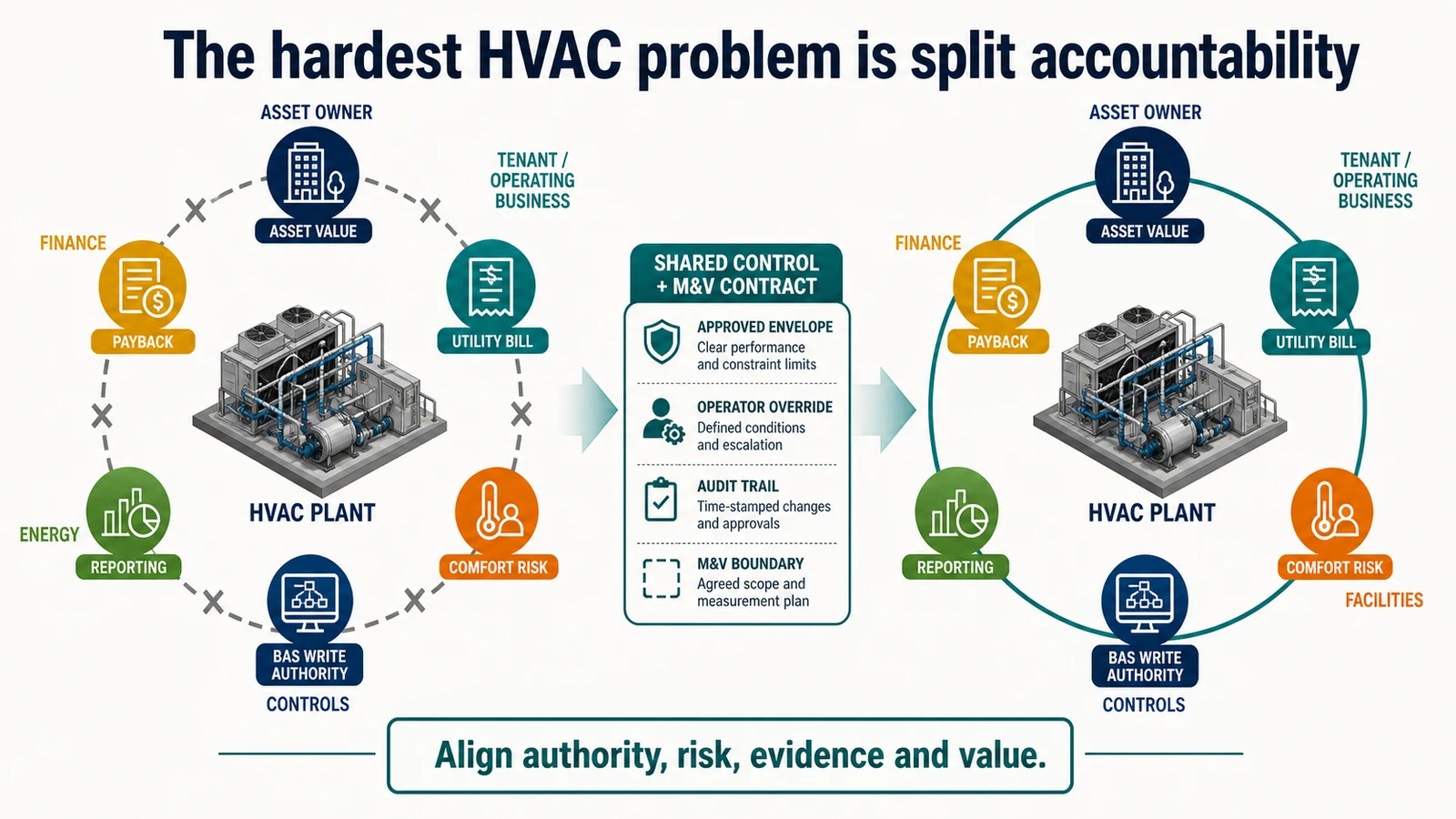
The hardest part of HVAC optimization is split accountability.
In many commercial buildings, the person who owns the asset, the person who pays the utility bill, the person who maintains the equipment, and the person who can approve BMS changes are not the same person.
That matters more than people think, because energy savings do not happen inside one clean org chart.
Different teams optimize different parts of the same building
The ownership map around a building is often fragmented. Each stakeholder may be rational, but each one is accountable for a different outcome.
- The owner may care about NOI, asset value, tenant retention, and capex timing.
- The tenant or operating business may be the one paying the utility bill.
- The facility team may own comfort complaints, vendor coordination, and daily operational risk.
- The controls contractor may be the only party trusted to touch the BMS.
- The energy team may own reporting, but not the equipment.
- Finance may want payback, but not disruption.
The technical opportunity is not enough
This is one reason HVAC efficiency projects stall even when the savings opportunity is real. The project may have a better sequence, a credible baseline, and a clear path to lower energy use.
But the decision still has to pass through questions that are not purely technical:
- Who approves the control change?
- Who carries the comfort risk?
- Who owns the meter boundary?
- Who gets credit for the reduction?
- Who pays if the savings are smaller than expected?
- Who decides whether the BMS can accept a new supervisory layer?
A vague accountability loop slows the project
If those questions are vague, the project slows down. Not because the algorithm is weak, and not because the building has no optimization potential.
The accountability loop is broken. The party with the budget may not carry the operational risk. The party with the operational risk may not benefit directly from the savings. The party that can change the BMS may not own the business case.
A good HVAC optimization plan has to respect that reality instead of assuming one buyer owns the full loop.
Supervisory control should be designed for split accountability
This is why the deployment model matters as much as the control model. A supervisory layer has to make the risk, authority, and evidence visible enough for multiple stakeholders to participate.
For a real building, that usually means:
- Shadow mode before closed-loop control.
- Operator override.
- Approved control envelopes.
- An audit trail for every recommended or executed action.
- Measurement and verification boundaries agreed before the pilot starts.
- A commercial model tied to verified outcomes, not just software access.
The product has to fit the building's operating reality
At ClimaMind, we think supervisory HVAC control has to fit the way buildings are actually owned, paid for, and operated.
Not the way a clean software diagram wishes they were.
In real buildings, the hard part is not only finding a better setpoint. It is helping the right people trust the change, share the risk, and agree on the result.