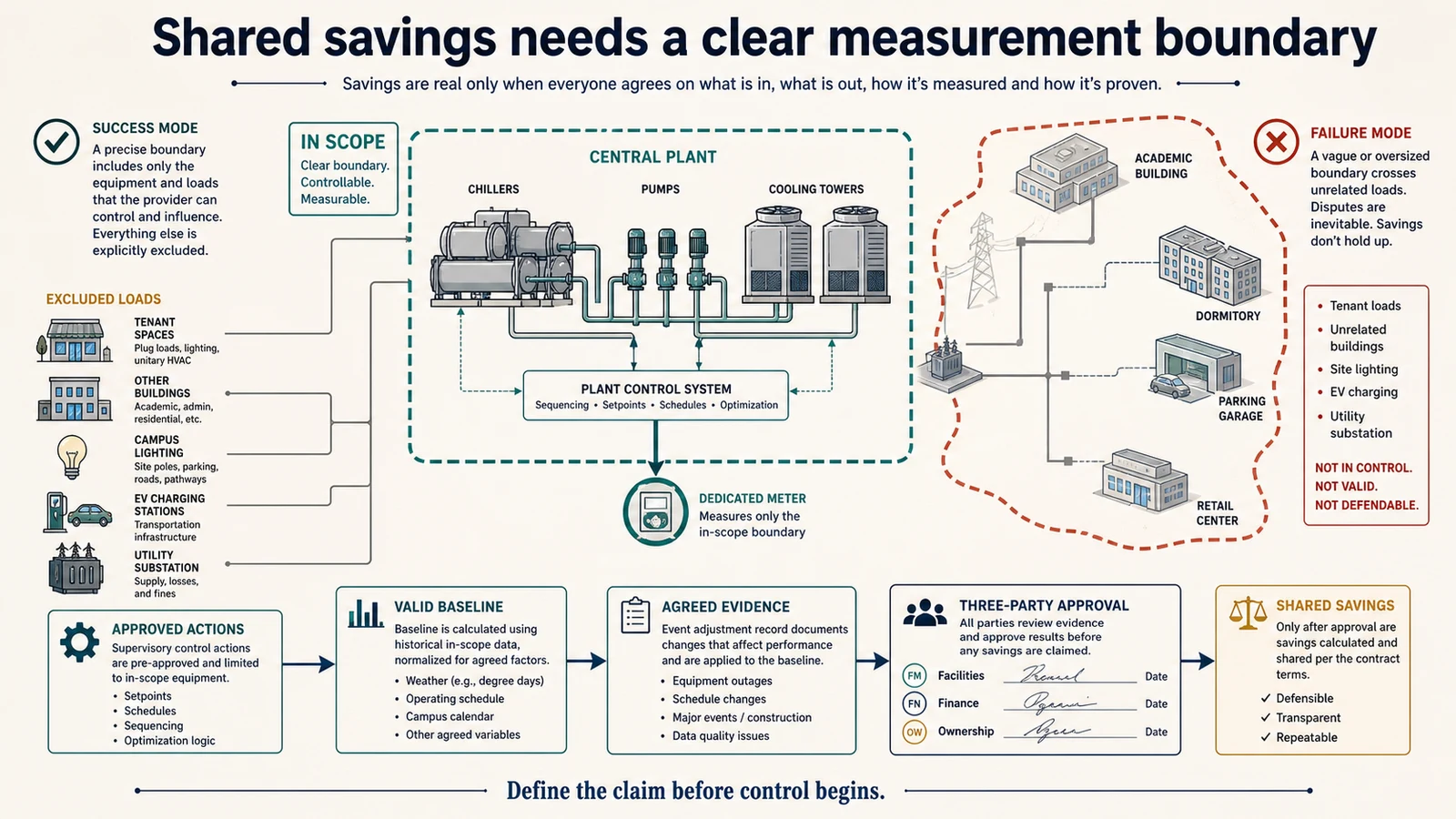
Shared savings sounds simple: reduce the energy bill, then share the value created.
In HVAC optimization, that model only works when the measurement boundary is clear before the project starts.
Otherwise the savings conversation can turn into an argument after the control work is already underway.
Was the reduction caused by the supervisory control layer, or by weather, occupancy, a schedule change, maintenance work, a tenant move, or a piece of equipment being replaced?
Measurement is part of deployment design
Measurement is not a final report that gets written after the pilot. It is part of the deployment design.
A control strategy and a measurement strategy have to describe the same operating reality. The system boundary, meter path, baseline period, excluded events, and operator override record need to be agreed before the building starts judging savings.
That does not mean every early pilot needs a full settlement-grade IPMVP package. It does mean the project needs a clear answer to what will count as evidence.
The boundary should be explicit before control begins
Before a building starts a shared-savings HVAC optimization pilot, these decisions should be visible to the facility team, energy owner, finance stakeholder, and asset owner.
- Which system is inside the measurement boundary.
- Which meters or BAS points will be used.
- Which control actions are in scope.
- Which loads are excluded.
- Which baseline period is valid.
- Which events require adjustment.
- Who approves overrides.
- What evidence is good enough for finance, facilities, and ownership.
A weak boundary can make a good project hard to defend
Without that agreement, even a technically successful project can become commercially weak.
The plant may operate better. The utility bill may go down. The facility team may like the control actions.
But if no one agreed on the boundary, the savings are hard to defend.
That matters because shared savings is not just a pricing model. It is a promise about accountability.
The measurement path should match the control path
If an HVAC optimization company wants to be paid based on outcomes, it has to show how control actions connect to measured impact.
A chilled water supply temperature reset, pump differential pressure reset, chiller staging change, or cooling tower strategy should not live in a separate story from the meter, baseline, excluded events, and operating evidence.
The measurement path should be designed alongside the control path, so the project can explain what changed, why it changed, which approved boundary allowed it, and what happened afterward.
Make measurement part of the operating model
At ClimaMind, this is how we think about shared-savings HVAC optimization: start with the existing BAS, define the control envelope, define the measurement boundary, run the pilot, keep the evidence visible, then talk about savings.
The strongest shared-savings projects do not wait until the end to ask how savings will be measured.
They make measurement part of the operating model from day one.