Buying HVAC optimization is a real procurement decision.
The facility team needs confidence that the system understands the plant. The energy team needs confidence that the savings evidence will hold up. The asset owner needs confidence that a broader rollout is worth the cost.
A useful pilot should be structured around that reality. The goal is to reduce uncertainty before the customer commits to a larger deployment.
Start with one suitable plant
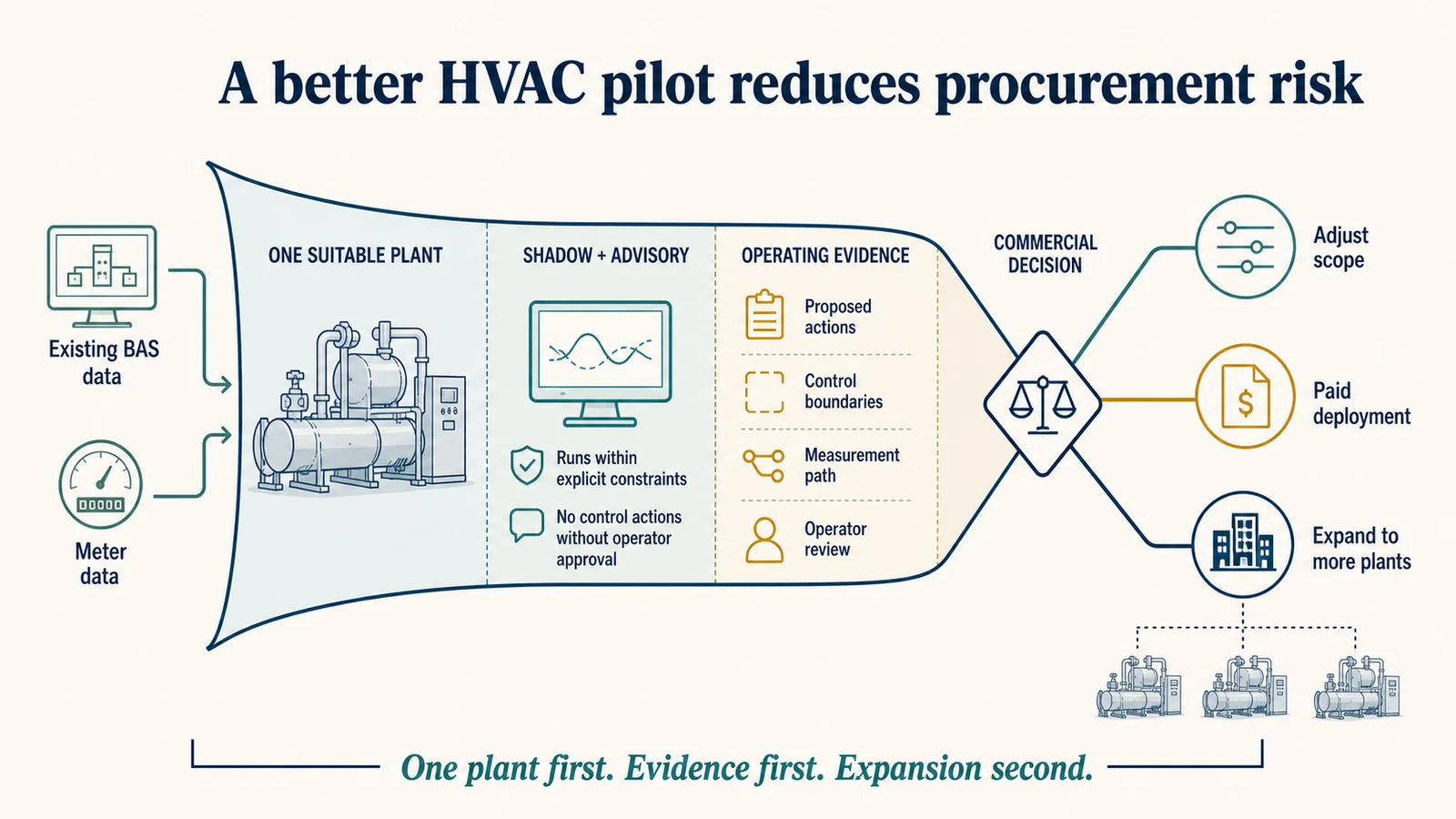
Start with one suitable central plant where BAS access, control points, and meter data are good enough to test the operating case.
That plant becomes the place to understand the real control surface: what can be observed, which setpoints or sequences may be changed, which actions remain advisory only, and which evidence path can support a later commercial decision.
This is a smaller decision than a portfolio rollout, but it is still a serious operating test.
Use the pilot to make the evidence visible
A procurement-safe pilot should show the control logic before it asks the customer to scale it.
The customer should be able to see the proposed actions, the approved operating envelope, and the measurement path in the same conversation.
- Connect to BAS and meter data.
- Run the optimization logic in advisory or shadow mode.
- Show the safe control opportunities.
- Make the measurement path visible.
- Let the facility team review the proposed actions and boundaries.
Tie the next commercial step to evidence
If one plant shows a clear opportunity, the next commercial step becomes much easier: move into a paid deployment and expand to additional plants or sites.
The buyer is no longer evaluating an abstract AI claim. They are evaluating plant-level operating evidence, measurement quality, operator confidence, and the expected path to repeatability.
If the evidence is weak, both sides learn that early, before the customer has committed to a larger procurement.
Reduce procurement risk without weakening the product
This framing is not about discounting the value of HVAC optimization. It is about matching the buying process to the operational risk.
A good pilot reduces uncertainty for the buyer, makes the operating case visible, and turns HVAC optimization from a broad promise into a measured decision.
That is especially important in buildings, where control authority, comfort risk, equipment protection, budget ownership, and savings accountability often sit with different teams.
Scale with evidence
At ClimaMind, we prefer a pilot path that starts narrow enough to be credible and rigorous enough to support expansion.
The sequence is simple: use one plant to prove the measurement path, the control envelope, the operator workflow, and the commercial case. Then expand where the evidence supports it.
One plant first. Evidence first. Expansion second.