Data centers are usually discussed as a power problem.
That is true, but more compute quickly becomes a cooling control problem.
More heat puts pressure on chillers, pumps, towers, air handlers, economizers, water systems, and control sequences. The common reaction is to add margin: more capacity, more redundancy, more conservative setpoints, and more manual rules.
In a mission-critical environment, that instinct makes sense. Uptime comes first.
Safety margin is not the same as unmanaged cooling margin
There is a difference between safety margin and unmanaged cooling margin.
A data center cooling system should not be optimized like a generic office building. The operating envelope is tighter, approvals are stricter, and the tolerance for black-box control is much lower.
That does not make optimization impossible. It makes control discipline more important.
The better question is the control boundary
For data centers, the useful question is not simply whether AI can reduce cooling energy.
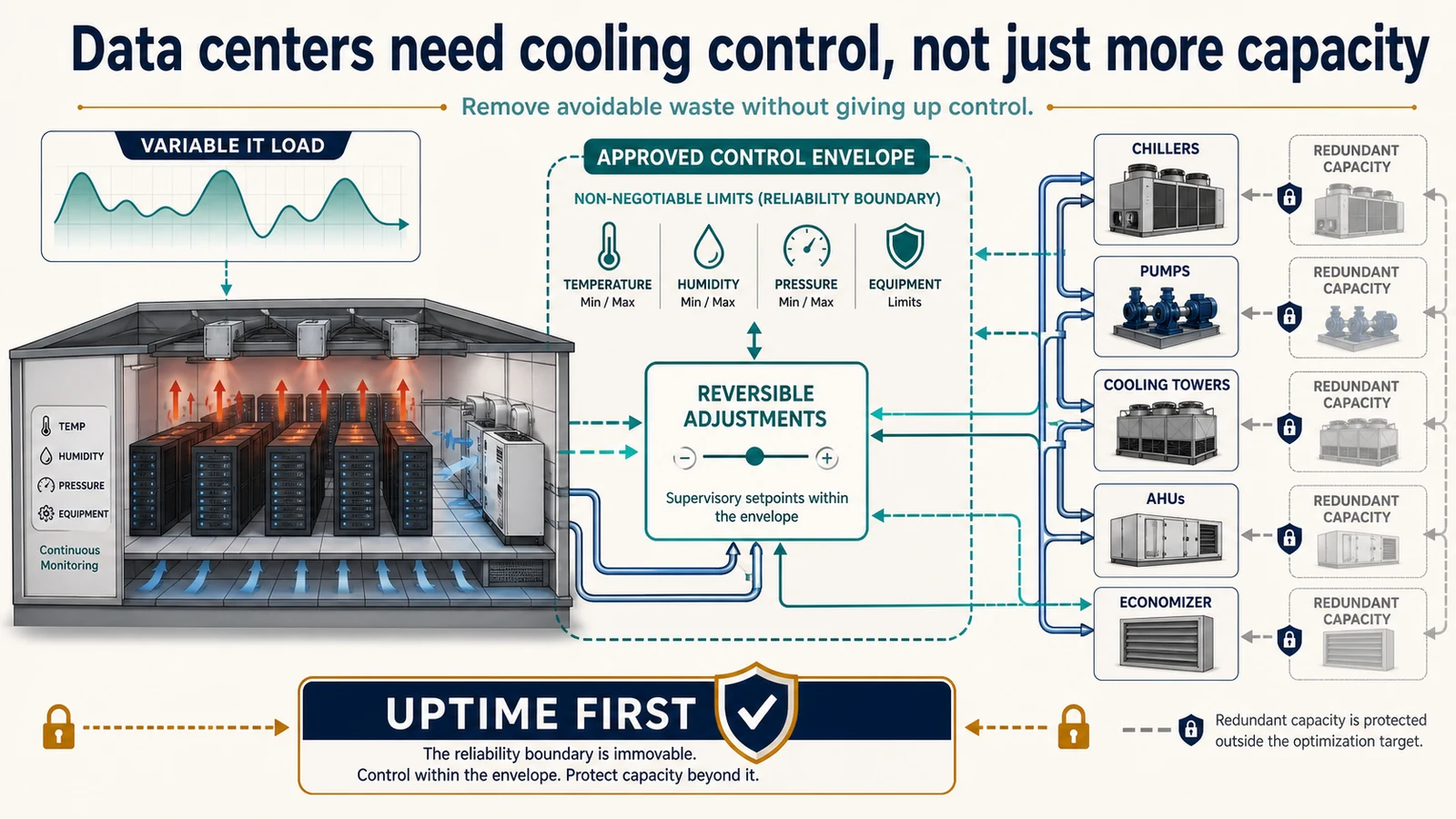
The better question is whether a supervisory control layer can improve cooling operation inside a boundary the critical facilities team would approve.
That boundary is what turns an optimization idea into an operationally acceptable control product.
The approved envelope should be explicit
Before any live control begins, the system should make the approved envelope visible.
- What the system can observe.
- What it can write back.
- Which temperature, humidity, pressure, and equipment limits are non-negotiable.
- When actions stay advisory.
- How override and rollback work.
- How each result is measured.
The control lever depends on the plant
For some sites, the opportunity may be chilled water reset, condenser water optimization, tower fan strategy, pump differential pressure, chiller staging, economizer coordination, or better response to changing IT load.
The exact lever depends on the plant. The principle does not.
Data center cooling optimization should not be framed as a tradeoff between efficiency and reliability. It should remove avoidable waste without asking the facility team to give up control.
Reliability-safe optimization needs evidence
At ClimaMind, this is how we think about AI HVAC optimization for critical environments.
Supervisory control on top of existing infrastructure, inside a visible envelope, with reversible actions and measurable results.
Data centers do not just need more cooling capacity. They need better cooling control.