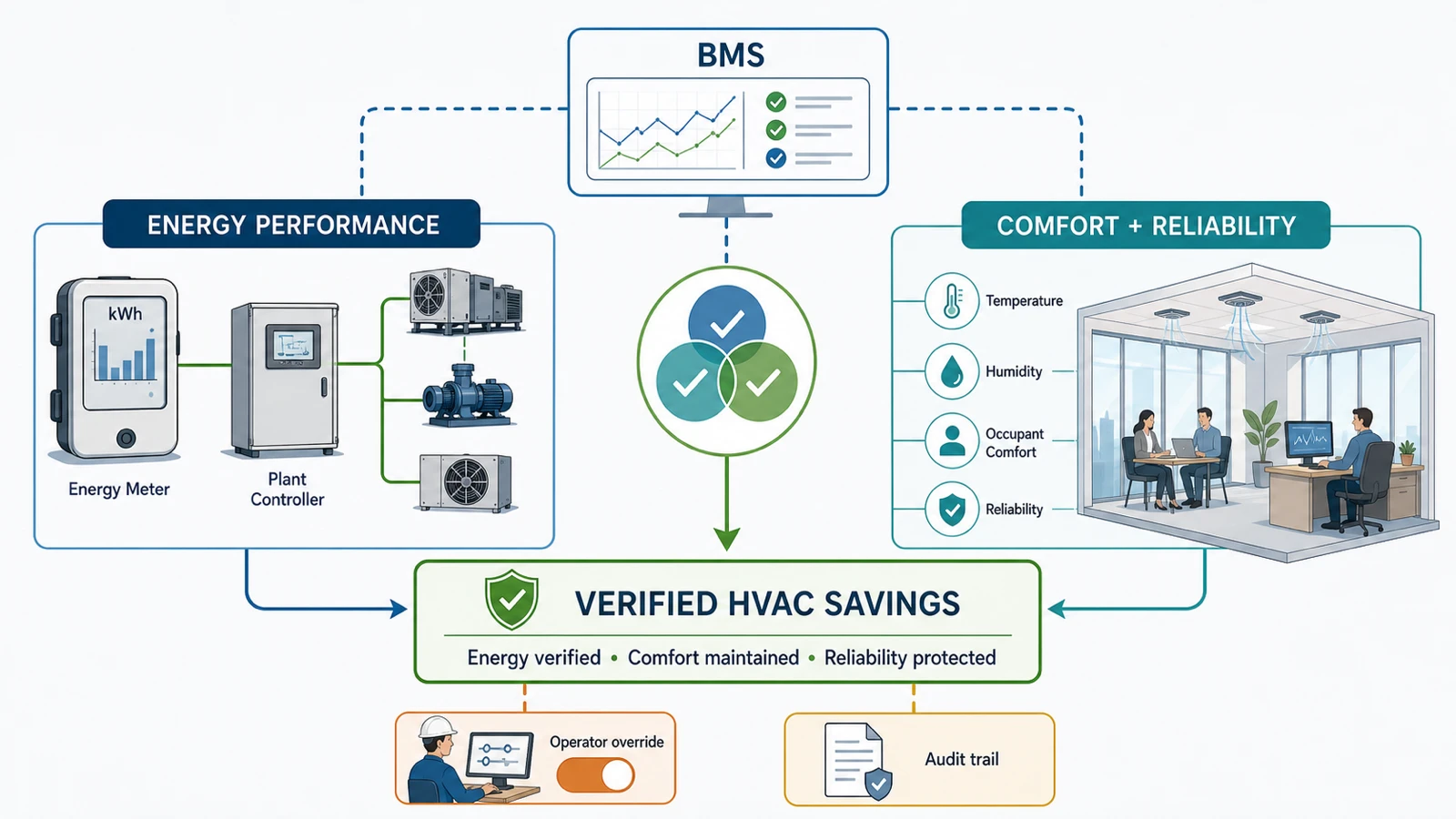
Lower energy use is not a complete HVAC outcome.
A building can reduce consumption and still produce a result that the owner should not accept: more hot and cold complaints, unstable humidity, disrupted critical spaces, or operators constantly overriding the control system.
That is why comfort should not appear as a footnote in an HVAC optimization pilot. It should be part of the savings contract.
Define success before control begins
Many energy projects define the meter boundary and baseline before the pilot starts. The same discipline should apply to comfort and reliability.
Before supervisory control begins, the facility team and project owner should agree on questions such as:
- Which zones or spaces are critical?
- What temperature and humidity conditions are acceptable during occupied hours?
- Which complaints or alarms require review?
- Which operating events allow an operator override?
- How long may a condition persist before the action is reversed?
- What happens to the savings claim when comfort or reliability criteria fail?
The exact answers will vary by building. An office, hospital, manufacturing facility, arena, and data center do not have the same operating obligations. The important point is that the acceptance rules are explicit before anyone asks the building to judge performance.
Comfort evidence belongs beside energy evidence
Comfort cannot be protected by a single average zone temperature.
A useful record may include representative zone temperatures, humidity where it matters, operating schedules, complaint or ticket logs, equipment alarms, operator overrides, and the control actions taken during the same period.
That evidence should be reviewed alongside the energy result.
If a supervisory controller changes a chilled-water setpoint, pump differential-pressure target, or equipment staging decision, the project should be able to show more than the energy impact. It should also show which comfort and reliability constraints were checked, whether the BMS accepted the command, and whether the facility team had to intervene.
A lower bill is not automatically accepted savings
Suppose a pilot reports lower HVAC energy use, but the same period includes repeated comfort complaints or a reliability event caused by the control strategy.
The energy result may still be useful operating evidence. It should not automatically become accepted savings for a performance contract.
A credible agreement distinguishes between:
- verified savings that meet energy, comfort, and reliability criteria;
- directional results that need more evidence;
- intervals affected by approved overrides or unrelated operating events; and
- periods that fail the agreed acceptance rules.
This protects both sides. The owner does not pay for a result that makes the building perform worse, and the optimization provider is not judged against comfort events or operational changes outside the agreed boundary.
Better rules make performance pricing more credible
Performance-based HVAC optimization depends on trust. Owners need confidence that savings were not created by quietly shifting risk to occupants or facility teams. Operators need confidence that the commercial incentive will not pressure the system to ignore the way the building actually has to run.
The strongest agreement aligns those incentives.
At ClimaMind, supervisory control operates through the existing BMS, inside site-approved limits, with operator visibility, override authority, and an evidence trail connecting control actions to measured results.
The objective is not the lowest possible energy number at any cost.
It is verified savings from a building that continues to meet its operating obligations.