Most HVAC optimization should not start with automatic control.
It should start with shadow mode.
That may sound cautious.
In real buildings, it is practical.
A central plant is not a place where a new system should immediately ask for full trust. Operators need to see how the system thinks before they allow it to change how the plant runs.
Shadow mode creates that bridge.
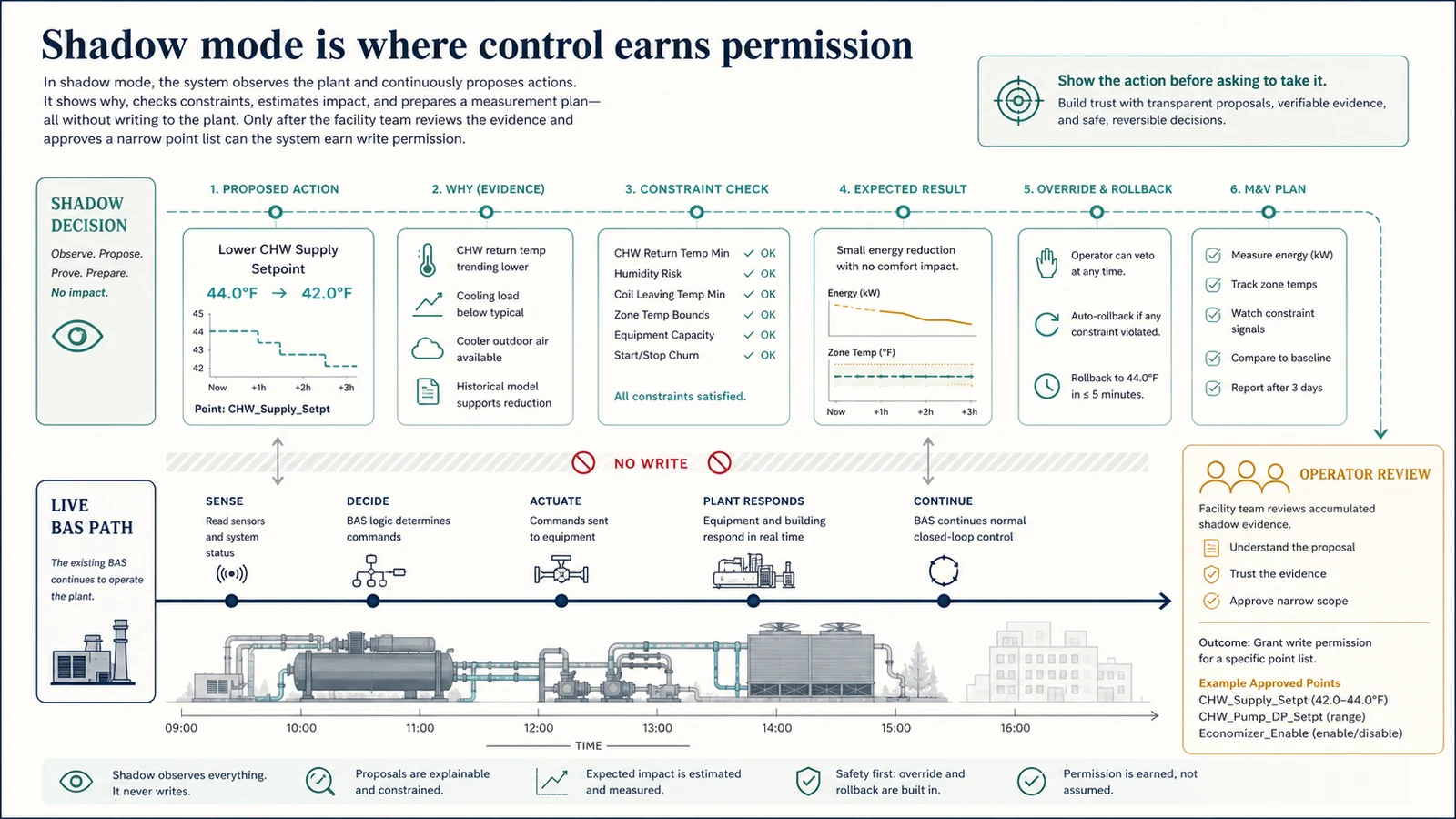
It lets a supervisory controller observe the BMS, evaluate plant behavior, and show what it would have changed without writing back to the building.
That matters because the first question is not only:
"Can the system find a better setpoint?"
The first question is:
"Would I have allowed that action?"
In a useful shadow mode, the system should make its judgment visible:
- which point it would adjust
- why that adjustment made sense
- which constraint allowed it
- which comfort and equipment limits were checked
- what it expected to happen afterward
- how the operator could override the action
- how the result would be measured
This is where HVAC AI earns permission.
Not by claiming autonomy.
By showing restraint.
By proving that it understands the control envelope.
By making every proposed action explainable before it becomes an actual action.
Shadow mode also helps separate real optimization from better analytics.
A dashboard can say:
"The plant was inefficient yesterday."
A shadow supervisory controller can say:
"At 8:15 tomorrow morning, under these load and weather conditions, I would raise this setpoint by this amount, inside this approved boundary, because the expected energy impact is favorable and comfort risk remains within limits."
That is a very different product.
It is not full automation yet.
But it is no longer just visibility.
It is control logic being tested against the building, the BMS, the operator's judgment, and the measurement path before live control begins.
At ClimaMind, this is how we think about trustworthy HVAC optimization:
Observe first.
Explain next.
Earn permission.
Then control inside an approved envelope.
Because in commercial buildings, the systems that last are not the ones that demand trust on day one.
They are the ones that make trust inspectable.