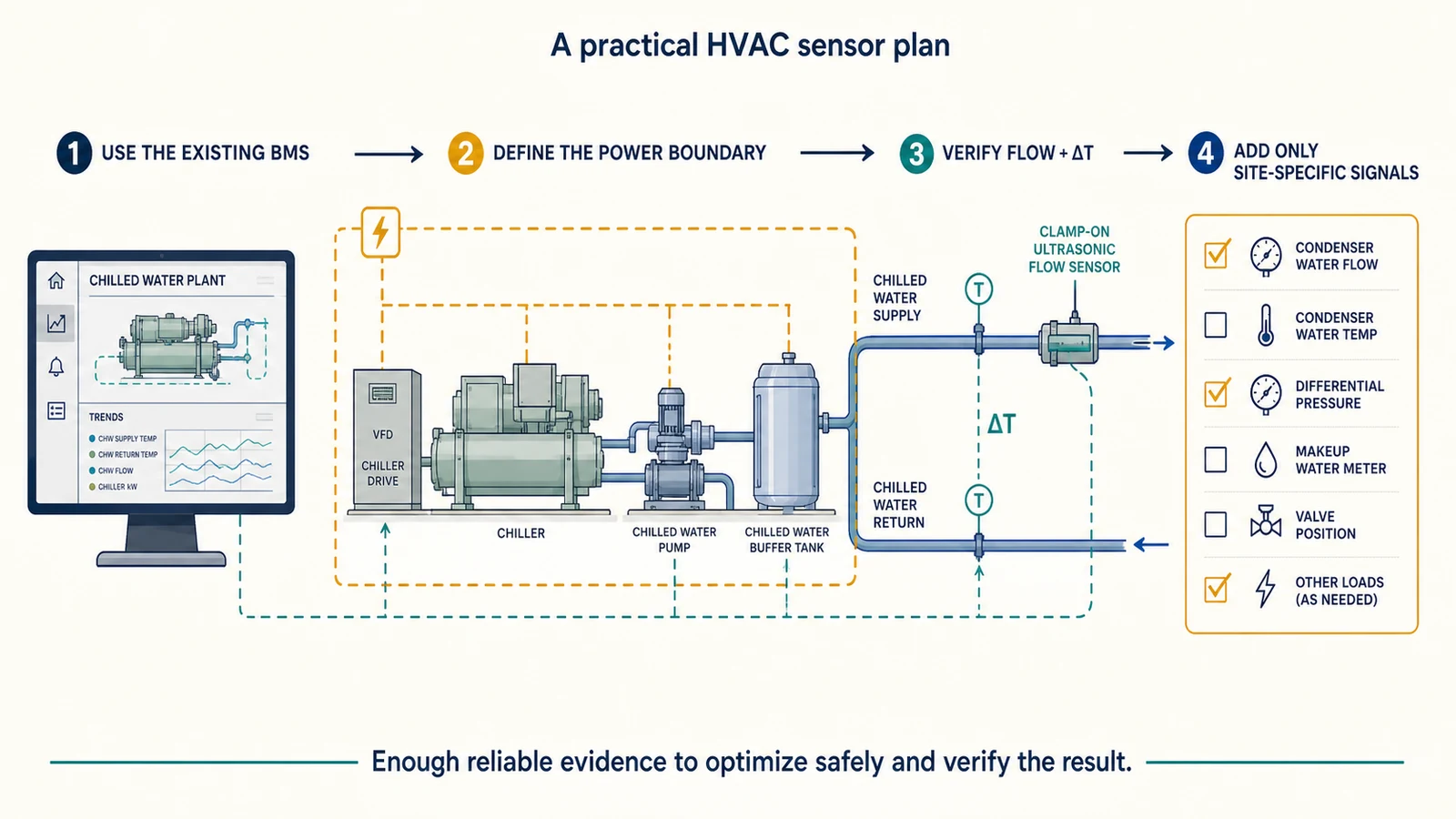
A practical HVAC optimization project does not begin with a large sensor installation. It begins by understanding what the existing BMS and meters can already tell us.
For a central plant, ClimaMind first reviews the plant diagram, BMS point list, trend history, existing meters, operating modes, and intended measurement boundary. That review shows which signals are usable, which ones need validation, and which gaps actually affect the project.
The objective is a focused measurement plan: use the infrastructure already in place, establish credible evidence for performance, and add only what the site-specific scope requires.
Start with a credible power boundary
For most central plant projects, reliable electrical metering is generally the basic minimum. The meter creates the power side of the measurement boundary and provides the evidence needed to compare plant operation before and during optimization.
The appropriate boundary depends on the facility. One project may use a chilled-water-plant electric meter. Another may need separate metering for chillers, chilled-water pumps, condenser-water pumps, cooling towers, or another defined equipment group.
Meter availability alone is not enough. The team should confirm that the reading covers the intended scope, has usable resolution, aligns in time with BMS trends, and remains reliable across the operating conditions included in the assessment. Without a credible electrical measurement path, measured savings can easily become a model estimate rather than an operating result.
Use flow to understand delivered cooling
Flow is usually the next measurement ClimaMind examines closely. Flow, together with supply and return water temperatures, supports an estimate of delivered cooling load and helps explain how plant power changes as load changes.
That combination matters because a lower power reading does not automatically mean the plant became more efficient. The load may have fallen, an equipment state may have changed, or the building may have entered a different operating mode.
Reliable flow and temperature data allow the facility team to compare power with useful thermal output, examine delta-T behavior, and evaluate plant performance on a more defensible basis. Existing BMS flow points may already be sufficient, but their units, scaling, timestamps, signal quality, and measurement location should be checked before they become part of the M&V path.
Consider non-invasive flow measurement
Missing or unreliable flow data does not automatically require a major piping retrofit. A clamp-on ultrasonic flow meter can provide a non-invasive option because its transducers are mounted on the outside of the pipe rather than inserted into the water loop.
Depending on the site, clamp-on measurement may support a temporary assessment, validate an existing BMS point, or provide an ongoing flow signal. It can reduce installation disruption, but it is not a universal answer.
Pipe material, diameter, wall condition, available straight run, fluid properties, whether the pipe remains full, installation quality, and required accuracy all affect suitability. ClimaMind and the facility team should confirm the proposed approach against the actual plant before treating it as a project requirement or measurement source.
Add only the signals the scope requires
Power and flow establish the center of the measurement discussion, but other signals may be necessary to interpret operating conditions or protect the approved control envelope.
The exact additions depend on plant topology, existing BMS coverage, data quality, optimization objectives, operating variability, control authority, and the agreed M&V method. Common candidates include:
- Supply and return water temperatures.
- Differential pressure at the agreed system boundary.
- Equipment status, speed, and power where the scope requires them.
- Outdoor dry-bulb or wet-bulb conditions relevant to plant operation.
- Process, comfort, or safety signals that define the approved control envelope.
Agree the site-specific plan before deployment
Different project stages can support different measurement requirements. An advisory assessment may begin with existing BMS trends and a plant-level electric meter. A supervised write-back deployment may require stronger signal reliability and clearer fallback evidence. A savings agreement may require a more formal metering boundary, baseline, normalization method, and treatment of excluded events.
ClimaMind therefore does not prescribe one universal sensor package. We review what the facility already has, explain why each material gap matters, and agree with the customer on the site-specific measurement requirements before the pilot or deployment begins.
That keeps the request proportional to the opportunity. The customer avoids an unnecessary hardware project, while the optimization team still has the evidence needed to evaluate plant behavior, operate inside approved boundaries, and verify the result.
The goal is enough reliable evidence to optimize safely and verify the result.