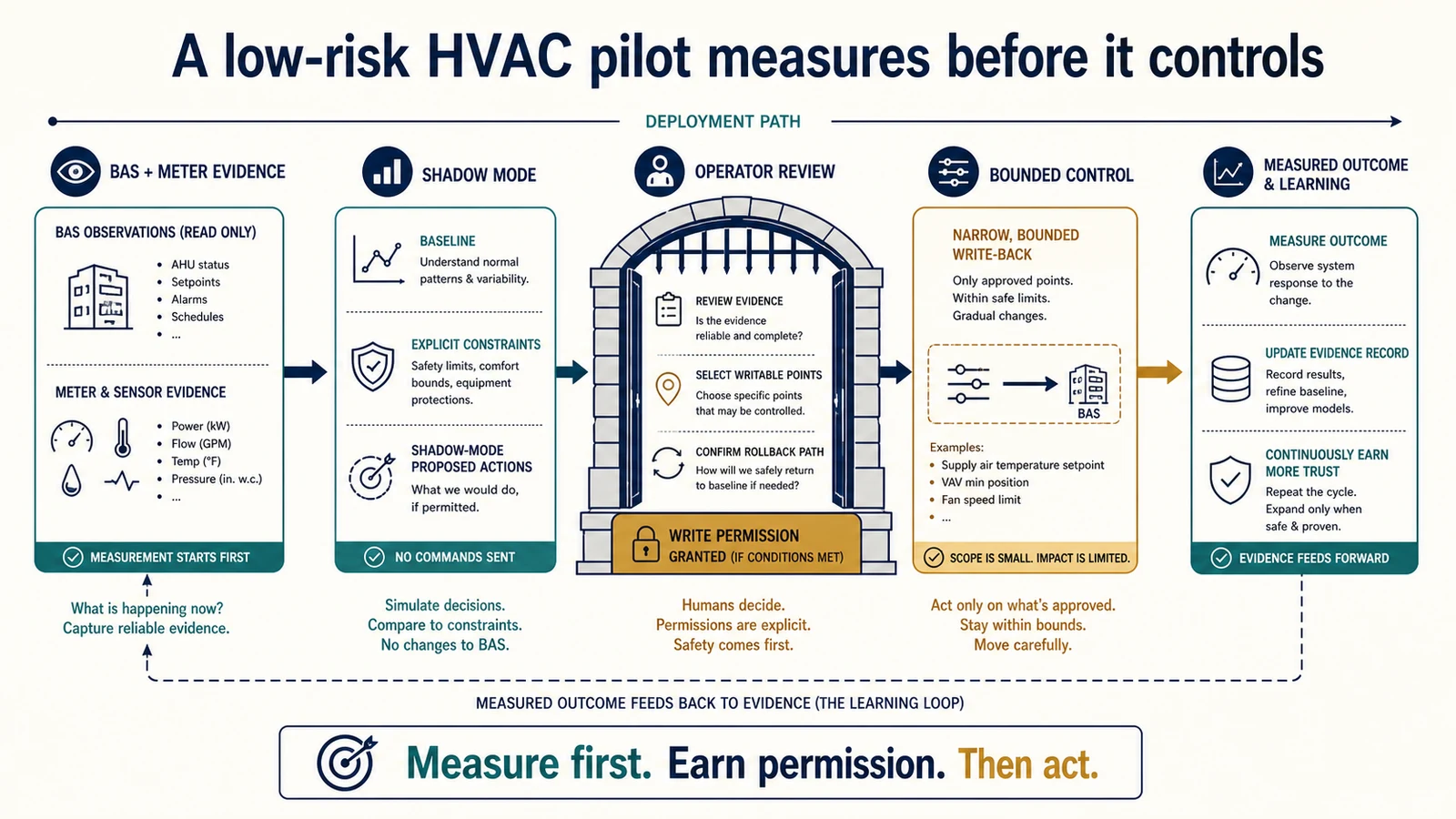
Most HVAC optimization pilots should not start by asking for write-back control.
They should start by measuring.
That is the practical way to make a pilot low-risk.
Before a building allows a new supervisory system to change setpoints, staging, resets, or schedules, the facility team should be able to answer a few basic questions:
- What can the system observe?
- Which BMS points are actually writable?
- Which control actions would it recommend?
- Which comfort and equipment constraints would stop an action?
- Which meter, trend, or baseline will be used to verify impact?
- How would an operator approve, reject, or roll back the change?
This is not delay.
It is how HVAC optimization earns permission.
A useful pilot can begin in advisory or shadow mode.
ClimaMind reads BMS and meter data, evaluates the plant, and shows the control actions it would have taken without writing back to the building on day one.
The customer can see the logic before accepting the automation:
"Under this load and weather condition, we would adjust this setpoint inside this approved envelope, because the expected energy impact is favorable and the comfort and equipment limits remain protected."
That is a very different pilot from a dashboard.
A dashboard shows that something was inefficient.
A shadow supervisory controller shows what it would have changed, why it would have changed it, and how the result would be measured.
Once that logic is visible, the next step becomes much easier:
Start with measurement.
Run in shadow mode.
Review proposed actions.
Verify the evidence.
Then move into supervised automation inside approved boundaries.
This is the right sequence for commercial buildings.
Not "trust the AI."
Not "replace the BMS."
Not "hand over control on day one."
Measure first.
Earn permission.
Then control only where the site has approved the envelope.
At ClimaMind, this is how we think a low-risk HVAC pilot should work.
The goal is not to make a bold automation claim.
The goal is to let a building try supervisory optimization before it has to trust live write-back.