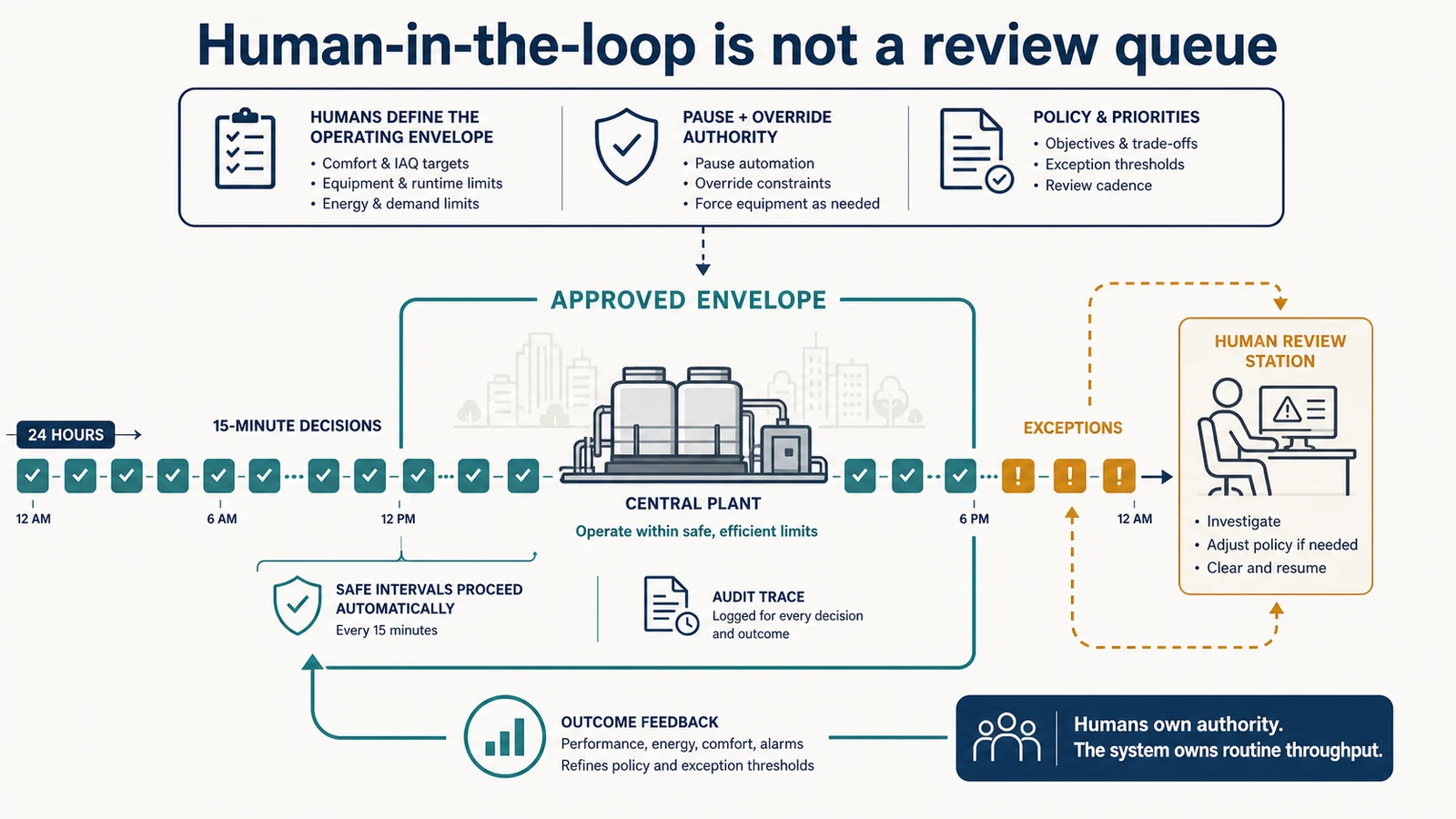
Human-in-the-loop should not mean reviewing every AI decision.
Manual review can be useful during early evaluation. It helps a facility team see how the system thinks before live control authority expands.
But it should not be the end state for operational AI in buildings, especially when the system is making a new control decision every 15 minutes.
No facility team can meaningfully review every interval-level decision while also owning comfort, equipment safety, tenant complaints, maintenance windows, and emergencies.
Human-in-the-loop can become liability transfer
A weak version of human-in-the-loop says the software will recommend actions and the operator will decide what to do. That can sound responsible, but in practice it can move the wrong burden to the building team.
If the product makes the decision and the operator gets the blame, the loop has not made the control safer. It has become liability transfer.
That turns the operator into the decision queue for software that claims to optimize the plant.
That is not a serious model for AI control.
The better model is approved envelopes, not endless approvals
The human role should be higher leverage. Humans define the mission, approve the control envelope, observe the system globally, challenge bad behavior, override when needed, and accept the results.
Inside that approved envelope, the AI system and the company behind it should be accountable for the decisions being made.
For ClimaMind, that means a 15-minute chilled water reset, staging recommendation, or other supervisory control action must be backed by visible reasoning, guardrails, an audit trail, and a measurement path.
Every interval decision should be explainable
If a supervisory controller changes a chilled water setpoint or recommends a control action, the system should be able to show the operating logic behind it.
- Why the action was taken.
- Which constraint allowed it.
- Which comfort and equipment limits were respected.
- What outcome was expected.
- What happened afterward.
- How the result is measured.
Oversight is authority, not manual throughput
Human oversight is essential. It keeps authority with the building team, makes control boundaries explicit, and gives operators the ability to stop, audit, and improve the system.
But human oversight should not require the operator to become the real-time decision engine for software. If the system is trusted enough to act every 15 minutes, it has to be accountable enough to explain every 15-minute action.
That accountability should come from bounded decisions, operator-visible constraints, reversible actions, and evidence that links control behavior to measured outcomes.
The practical model is accountable autonomy
The goal is not black-box autonomy, and it is not endless manual approval.
The building team should own the mission, constraints, and acceptance standard. The system, and the company behind it, should own the decisions made within that boundary.
Accountable autonomy inside an operator-approved envelope is the model that can work in commercial buildings.
Human-in-the-loop should mean human authority. It should not mean human review of every machine-speed decision.