Event Schedules Belong in the HVAC Control Loop
A building can look completely different to its HVAC system from one day to the next.
An arena may be quiet in the morning and full that evening. A university may move from a normal class day to commencement. A conference center may turn over between two events with very different occupancy and setup requirements.
The event calendar already tells the operating team that the building is about to change.
The HVAC control strategy should know too.
A schedule is an operating input
Many BMS schedules reduce the building to a familiar pattern: occupied, unoccupied, weekday, weekend, holiday.
That is a useful foundation. It is not always enough for buildings whose real demand follows events.
A special event can change:
- when the building needs to be ready;
- which spaces will be used;
- how quickly occupancy will rise and fall;
- which comfort and ventilation conditions matter most;
- how much cooling capacity should remain in reserve; and
- when recovery can begin after people leave.
Those are operating conditions, not calendar trivia.
If the control system cannot see them, operators have to translate the event plan into manual schedule changes, early starts, overrides, and conservative equipment staging. That can protect reliability, but it also makes the result harder to repeat, explain, and improve.
The calendar does not replace plant data
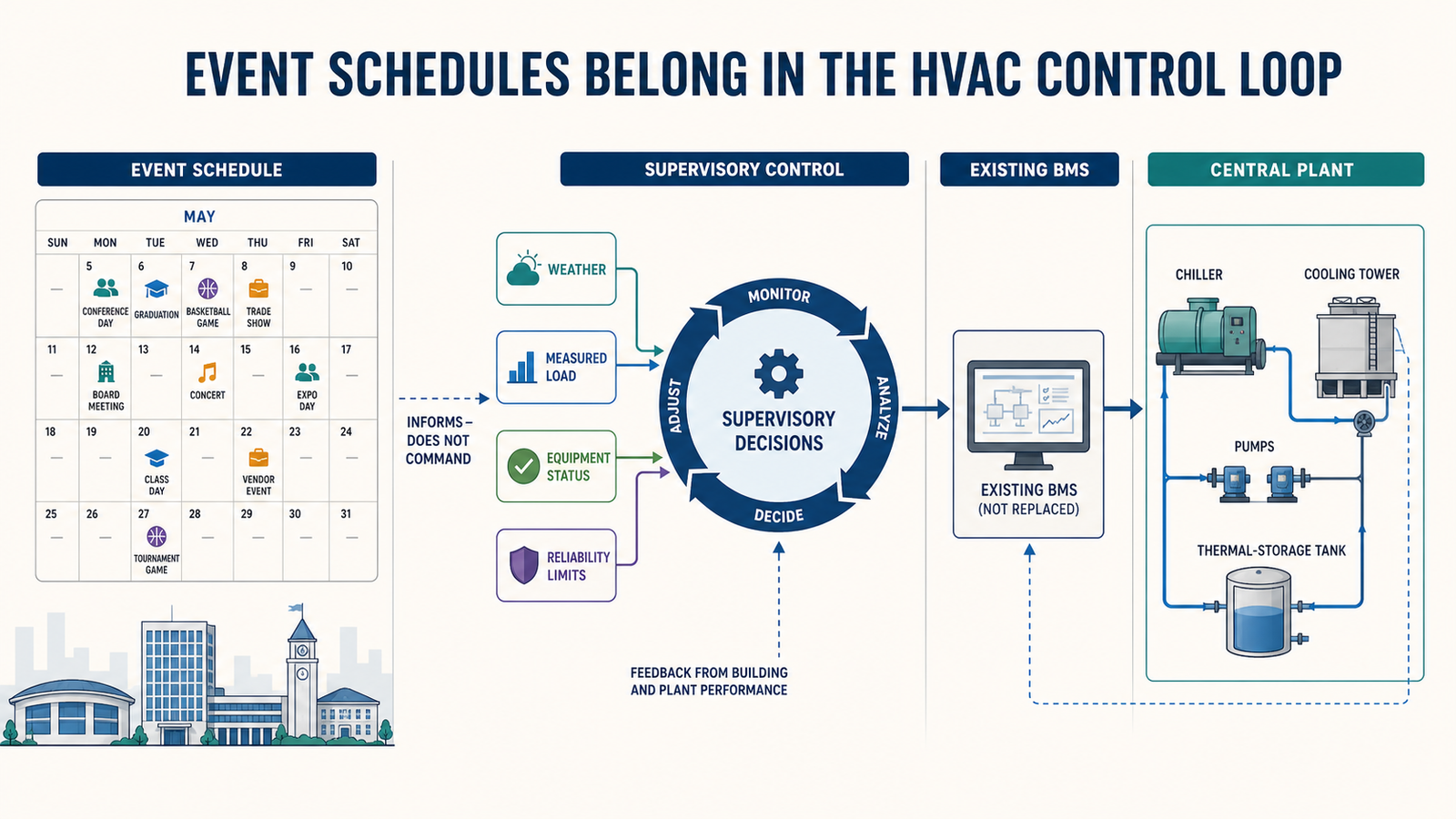
An event schedule should not issue equipment commands by itself.
A calendar entry cannot confirm the outdoor conditions, the actual building load, the state of thermal storage, or whether a chiller, pump, or cooling tower is available. Events can start late, end early, or draw a different crowd than expected.
The schedule is one input to a larger decision.
A supervisory controller can combine it with measured BMS conditions, weather, equipment status, utility economics, and site-approved constraints. The operating team can then define what the system may prepare in advance, what it may adjust during the event, and when reliability should override an energy objective.
The existing BMS remains responsible for local control and protective logic. Operators retain override authority. Every supervisory action should remain visible, bounded, and reversible.
Reliability belongs in the plan
For an event-driven building, the most efficient decision on an empty day may be unacceptable before a sold-out event.
That does not make optimization irrelevant. It changes the objective.
The system may need to pre-condition selected spaces, preserve thermal-storage inventory, stage additional equipment, or hold a wider reliability reserve. After the event, the better decision may be to reduce capacity sooner instead of following the same conservative sequence for the rest of the night.
Optimization should respect those obligations rather than treat them as exceptions discovered after a complaint or alarm.
Event context also makes savings more credible
Event and non-event days should not be compared as if they were operationally identical.
When the event calendar is part of the operating record, the project can explain why the plant prepared differently, which constraints were active, and whether the observed energy use belongs in the same measurement segment.
That makes measurement and verification more defensible. A high-load event does not automatically look like poor performance, and an empty-building interval does not create artificial savings.
The calendar helps connect energy results to the building activity that produced them.
Better control starts before the crowd arrives
Event-driven facilities do not need another static schedule for every possible day.
They need a control process that can see what is coming, confirm what is actually happening, and adjust the plant inside an approved operating envelope.
At ClimaMind, we build supervisory optimization on top of the existing BMS so central plants can respond to changing building use while preserving operator visibility, reliability constraints, and measurable results.
The event calendar is already part of building operations.
It belongs in the HVAC control loop.