Many central plants are still operated around assumptions that were correct when the sequence was written.
The utility rate was different.
The building schedule was different.
The equipment was newer.
The reliability strategy had a different purpose.
But the sequence remained.
California offers a useful historical example.
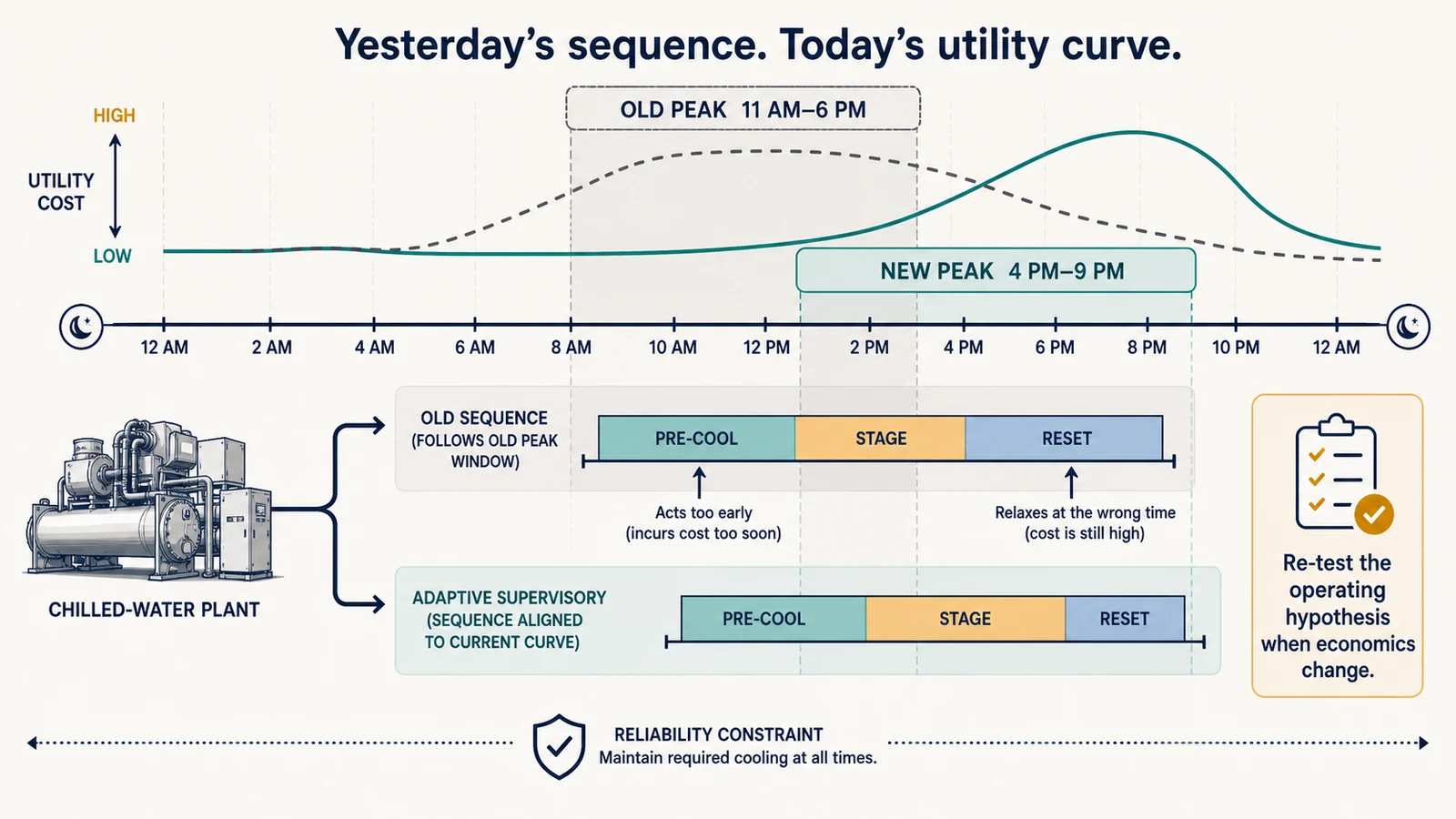
For decades, San Diego Gas & Electric’s summer on-peak period ran from 11 a.m. to 6 p.m. on weekdays.
Then solar changed the economics of the grid.
Midday electricity became more available. The system’s costly and reliability-critical hours shifted later, into the evening ramp. The utility moved toward a 4 p.m. to 9 p.m. on-peak period.
Same grid.
Different cost curve.
Different answer.
Now consider a central plant whose demand-limiting sequence was written for the old peak window.
It pre-cools before the afternoon peak. It relaxes chiller staging after 6 p.m. It assumes the most expensive operating hours are already behind it.
Then the peak moves later.
The BMS keeps following the same sequence—while the tariff and the building’s real cost exposure have changed.
This does not mean the original sequence was wrong.
It means a control sequence is an economic hypothesis.
And hypotheses should be re-tested when the system around them changes.
This is where supervisory control becomes useful.
Not as a replacement for the BMS.
Not as an excuse to ignore operator judgment or reliability reserves.
But as a way to continuously evaluate approved decisions such as:
- when to pre-cool or pull back
- which chiller and pump combination to stage next
- how far to reset chilled-water or condenser-water temperatures
- when a reliability constraint should override an energy objective
The first step is not autonomous control.
It is making the existing operating logic visible, testing whether its original assumptions still apply, and measuring what a better sequence would do inside an approved envelope.
The most expensive HVAC rule is often not a bad rule.
It is an old rule that nobody has revisited.
Historical reference: CPUC record on the shift in California peak periods.
At ClimaMind, we build supervisory optimization for central plants that need to adapt without giving up operational control.