HVAC capital planning often begins with familiar evidence: equipment age, service history, repair frequency, and a recommendation from someone who knows the plant.
Those inputs matter. But they do not always show why the system is underperforming.
A chiller may appear inefficient because it is nearing the end of its useful life. It may also be operating at the wrong load, fighting another machine, or following a sequence written for different conditions. A pump may need replacement, or it may simply be maintaining more pressure than the building requires.
These situations can look similar on a utility bill. They lead to very different investment decisions.
Operating data helps owners tell them apart.
One performance problem can have three different causes
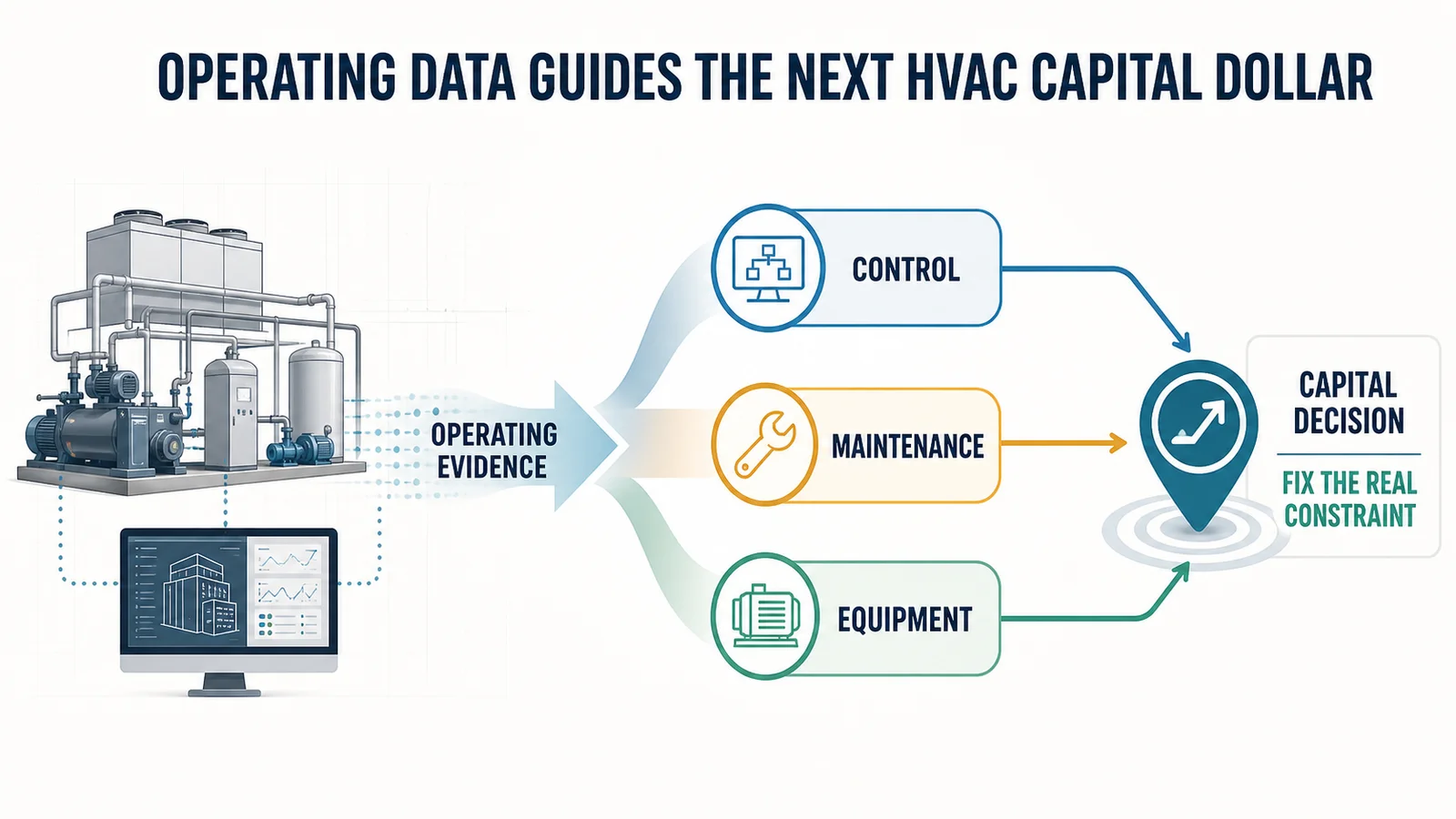
Most HVAC performance gaps contain some combination of three issues:
- Control issues: setpoints, schedules, staging, or coordination are not adapting to actual building conditions.
- Maintenance issues: sensors, valves, dampers, heat-transfer surfaces, or mechanical components are no longer performing as intended.
- Equipment constraints: capacity, efficiency, redundancy, or remaining service life creates a limit that better operation cannot remove.
Treating every problem as a capital project can replace equipment before its operating value has been fully understood.
Treating every problem as a controls problem can delay a repair or upgrade the building genuinely needs.
The better approach is to identify which constraint is active, how often it matters, and what happens after a safe operating change is tested.
A snapshot is not enough for a capital decision
A plant inspection captures an important moment. Capital planning becomes stronger when that engineering judgment is paired with evidence across changing loads, weather, schedules, equipment availability, and utility conditions.
The existing BMS, meters, and maintenance records can help answer practical questions:
- Does the equipment reach its limit only during rare peaks or throughout normal operation?
- Does performance improve when staging, setpoints, or schedules change?
- Are comfort and reliability maintained when the plant operates differently?
- Is one component creating a persistent system constraint?
- Does the remaining performance gap justify repair, recommissioning, or replacement?
This evidence does not replace a mechanical engineer, contractor, or formal condition assessment. It gives those experts a clearer operating record on which to base their recommendations.
Optimization can create better investment evidence
ClimaMind works as a supervisory optimization layer on top of the existing BMS. Within site-approved boundaries, it can evaluate operating conditions, recommend or apply bounded changes, and record how the plant responds.
That process can create evidence a capital committee can use:
- the operating constraint that was observed;
- the control or maintenance intervention that was attempted;
- the resulting energy, comfort, and reliability performance;
- the conditions under which the constraint remained;
- the equipment investment that would address the remaining gap.
The purpose is not to argue against necessary mechanical upgrades. It is to make the case for each upgrade more specific, measurable, and defensible.
The next capital dollar should solve the next real constraint
Owners rarely have unlimited HVAC budgets. Every proposed chiller, pump, control panel, sensor package, or plant modification competes with other building priorities.
Operating evidence improves that allocation decision.
It can show where better control is enough for now, where focused maintenance should come first, and where the equipment itself has become the binding constraint.
The result is not simply lower capital spending. It is a clearer connection between the money invested and the operating problem it is meant to solve.
Before approving the next HVAC upgrade, ask one more question:
What does the building's operating data say the next dollar should fix?