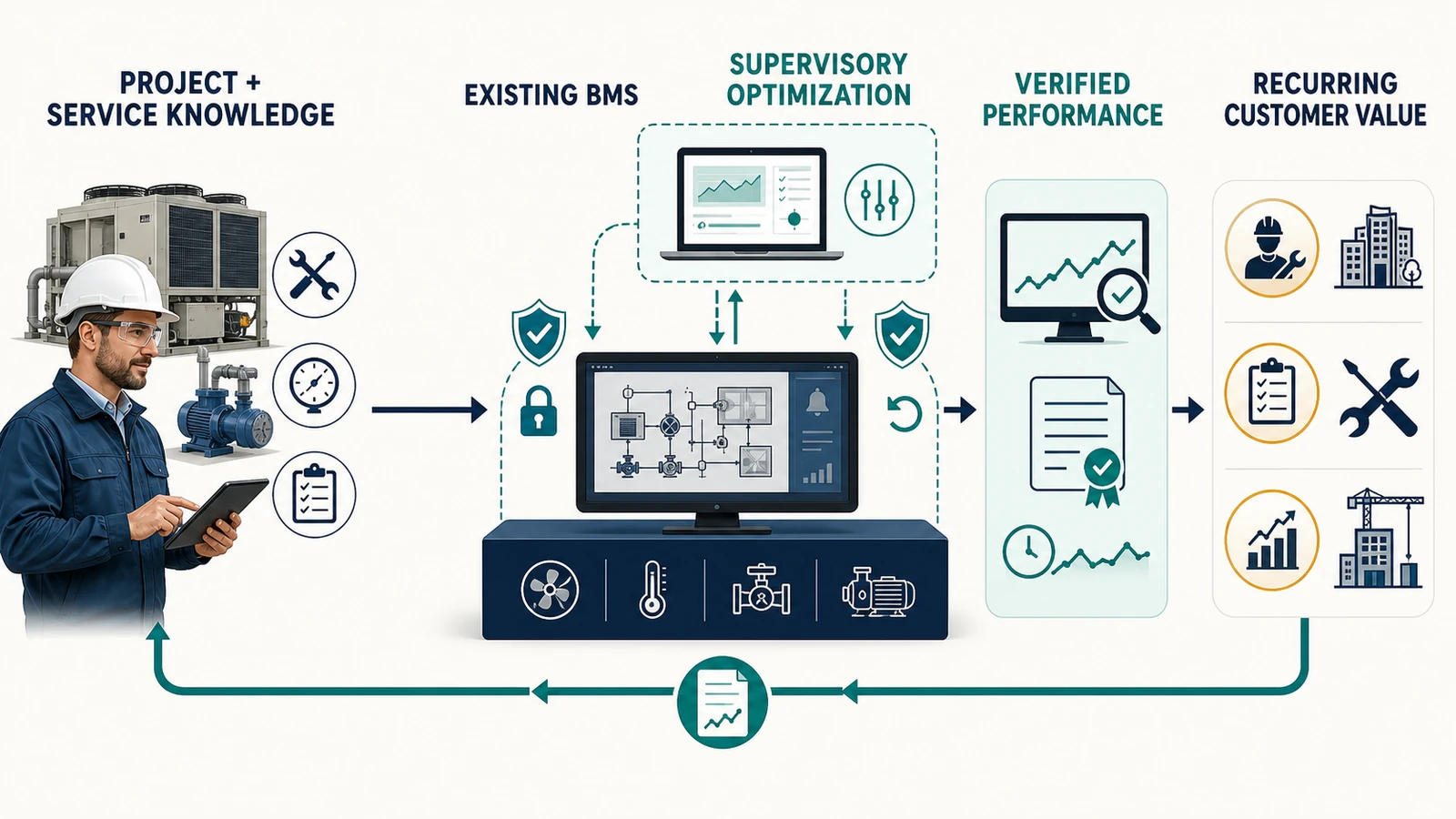
Mechanical contractors already help owners make some of their most important HVAC decisions.
They understand the equipment, the installation history, the service problems, and the people responsible for keeping the building running. They are often present when a plant is upgraded, recommissioned, repaired, or struggling through an operating issue.
That relationship can create value long after the project is complete.
By adding continuous optimization to the existing service model, mechanical contractors can help customers improve how their HVAC systems operate—not only how they are installed and maintained.
Project knowledge can become operating value
A successful mechanical project leaves behind more than equipment.
It creates practical knowledge about plant topology, equipment limits, control sequences, sensor quality, known failure modes, and the way operators actually use the building.
Much of that knowledge becomes less visible after closeout. The BMS continues running. Loads, weather, occupancy, tariffs, and equipment condition continue changing. Operators make necessary adjustments. Temporary overrides accumulate. The plant gradually moves away from the conditions seen during design or commissioning.
Ongoing optimization gives the contractor a way to keep that project knowledge active.
Instead of returning only when equipment fails or a customer requests another capital project, the contractor can help monitor operating performance, identify emerging constraints, and show where control changes or mechanical work will create the most value.
The existing BMS remains the operating foundation
Continuous optimization does not require the contractor to replace the BMS or take authority away from the facility team.
A supervisory controller can operate above the existing BMS and within site-approved boundaries. It can evaluate plant load, equipment availability, weather, schedules, comfort requirements, and utility conditions before proposing or applying bounded changes to approved setpoints and sequences.
The BMS still handles local control and protective logic. Operators retain visibility and override authority. Actions remain logged and reversible.
That division of responsibility matters. It allows the contractor to add a performance layer while preserving the controls infrastructure and operating relationships the customer already trusts.
Recurring value needs measurable responsibility
A recurring service should be tied to outcomes the customer can evaluate.
That means agreeing on the baseline, measurement boundary, operating exclusions, comfort and reliability constraints, and verification method before performance is judged.
The resulting service can answer concrete questions:
- Is the plant using less energy under comparable operating conditions?
- Are comfort and reliability staying inside agreed limits?
- Which supervisory actions contributed to the result?
- Which problems require maintenance, recommissioning, or capital investment?
- When did an operator override or external event change the outcome?
This evidence protects the customer from vague savings claims. It also protects the contractor from being held responsible for conditions outside the agreed control and measurement boundary.
Optimization strengthens the full service relationship
Continuous optimization is not a substitute for mechanical expertise.
Software cannot repair a failed compressor, correct a piping problem, or add capacity where the plant is undersized. It can help reveal when those interventions are necessary—and when better operation should come first.
That creates a stronger customer relationship. The contractor can connect installation, maintenance, controls, and measured performance into one operating conversation. Capital recommendations can be supported by evidence. Service visits can focus on the constraints that matter. Customers can see progress between major projects instead of waiting for the next failure or budget cycle.
At ClimaMind, we see mechanical contractors as natural partners for this model. They bring trusted customer access and site knowledge. ClimaMind adds bounded supervisory control, operator-visible actions, and measurement and verification through the existing BMS.
The result is a service relationship built around continuing HVAC performance—not only completed project scope.