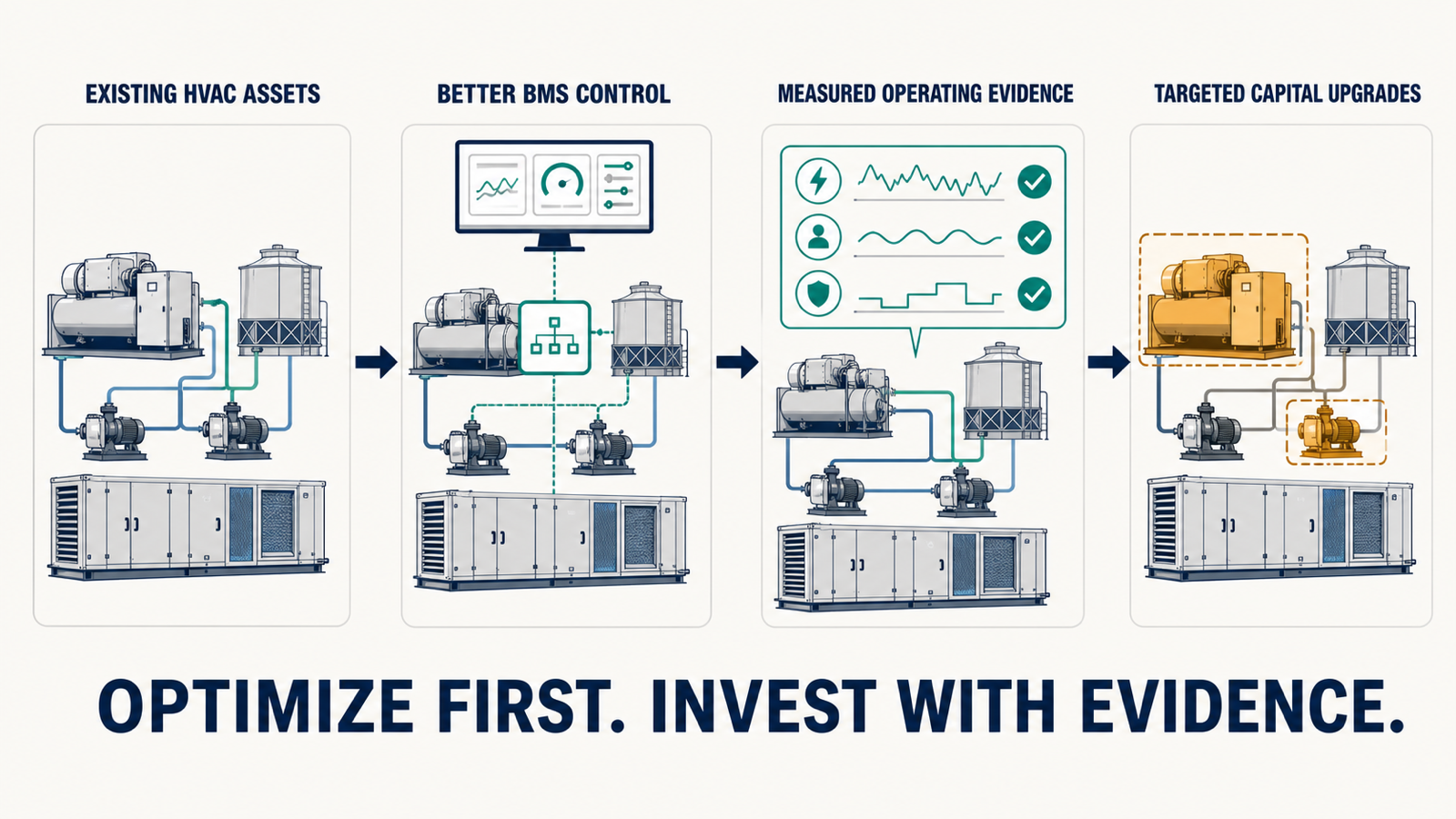
Many facility teams know that parts of their HVAC system should eventually be upgraded.
The constraint is often not awareness. It is capital.
Chillers, pumps, cooling towers, air-handling equipment, sensors, and control panels compete with every other investment in the business. Even a well-supported efficiency project may wait through multiple budget cycles before funding becomes available.
An ESCO can be the right answer for a larger retrofit. But it is not the only path to better HVAC performance.
There is also a lighter first step: improve how the equipment already in place is operated.
Existing equipment may have more operating value to release
Mechanical equipment defines what a plant can physically do. The BMS and its control sequences determine how that capability is used from hour to hour.
A plant can contain serviceable equipment and still operate inefficiently because setpoints remain static, pumps maintain more pressure than the load requires, equipment stages at the wrong time, or subsystems work against one another.
Those are not automatically equipment-replacement problems. They may be operating problems.
ClimaMind works as a supervisory control layer on top of the existing BMS. It uses the site's available operating data to identify better setpoints and sequences, while respecting approved comfort, equipment, schedule, and operator constraints.
The goal is to release more value from assets the building already owns before asking the customer to approve a major capital project.
Optimize first, then invest with better evidence
Software control does not eliminate the need for mechanical upgrades. A failed compressor still needs repair. An undersized plant still has a capacity problem. Obsolete controls, unreliable sensors, and damaged equipment can create hard limits that optimization should not pretend to solve.
But better operation can help separate those hard equipment constraints from correctable control problems.
That creates a more useful investment sequence:
- Use the existing BMS, meters, and operating records to understand current plant behavior.
- Improve the control decisions that can be changed safely without replacing major equipment.
- Measure the resulting energy, comfort, and reliability performance.
- Use that evidence to identify the equipment upgrades that still have a strong operational and financial case.
The result is not simply deferred spending. It is better-targeted spending.
A lighter starting point can still be accountable
A software-first step should still have a clear engineering boundary.
The facility team should know which BMS points are being observed, which setpoints may be adjusted, what constraints remain fixed, how operators can override or roll back an action, and how performance will be measured.
ClimaMind can begin with observation or shadow mode before receiving write permission. As confidence grows, approved control actions can move into supervised automation. The BMS remains the local system of record, and the building team retains operating authority.
This approach is lighter than a full equipment retrofit, but it is not a shortcut around safety, commissioning, or measurement and verification.
Capital constraints do not have to stop operational progress
For organizations with limited capital expenditure budgets, the choice does not have to be a major retrofit or no improvement at all.
Better control can create a practical middle path. It can improve the operation of existing assets, reveal where equipment limits are real, and build a stronger evidence base for the upgrades that deserve funding next.
The most useful first question may not be, "What equipment should we replace?"
It may be, "How much better can this system perform with the equipment we already own?"