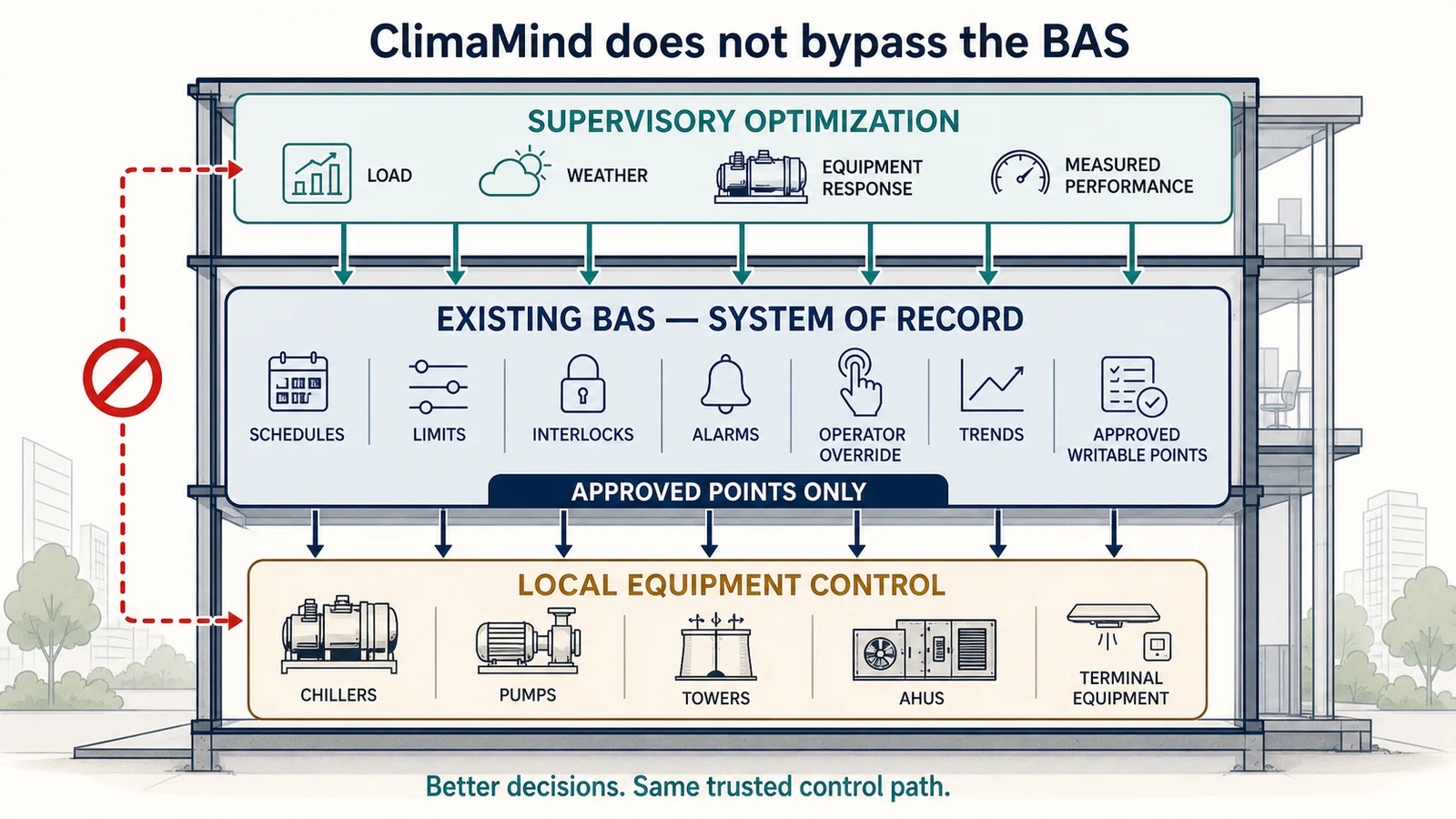
Why ClimaMind would not break your HVAC system, Part 1: it does not ask the building to abandon the control structure it already trusts.
When people hear AI control, they often imagine an outside system taking over chillers, pumps, towers, air handlers, and terminal equipment directly.
That is not how safe HVAC optimization should be designed.
The BAS is more than a dashboard
In a real facility, the building automation system is not just a place to view temperatures and alarms.
It is the system of record for schedules, setpoint limits, equipment modes, interlocks, alarm visibility, trend logs, operator overrides, and site-specific control sequences.
That structure is not incidental. It is how the building stays understandable, serviceable, and safe for the people responsible for it.
The design question is the path to the building
The first design question is not only whether an algorithm can find a more efficient setpoint.
The more important question is how that setpoint reaches the building.
Can optimization improve operation without bypassing the system of record?
Supervisory control should sit above the BAS
ClimaMind is designed as a supervisory optimization layer above the existing BAS.
It does not replace the BAS, command equipment directly around it, remove operator authority, or require every point in the building to become writable.
For a central plant, the approved control surface may include bounded adjustments to chilled water supply temperature reset, condenser water temperature reset, pump differential pressure reset, cooling tower speed strategy, or chiller staging limits.
The path matters as much as the recommendation
Those decisions are not exotic AI commands. They are ordinary BAS-level operating decisions that many buildings already expose.
The difference is that a supervisory layer can help choose them continuously using load, weather, equipment response, comfort limits, and measured performance.
But the action still goes through approved BAS points. The BAS still sees the command. The local control logic still runs. The site team still has authority.
The first safety principle is architectural
This is the first reason ClimaMind would not break your HVAC system.
Not because HVAC is simple. Not because an algorithm is automatically safe because it is AI.
Because the existing control architecture is treated as the foundation, not an obstacle.
Part 1 is simple: do not bypass the BAS. Part 2 can go deeper on constraints, overrides, rollback, and bounded write permission.